
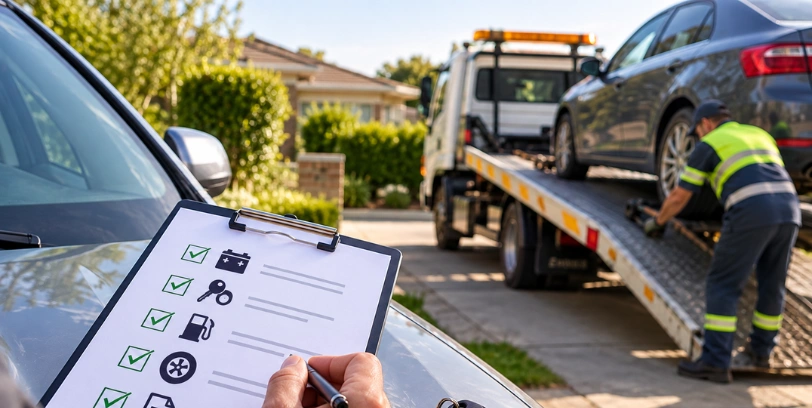
A tilt tray weighs around eight tonnes empty. It needs roughly three metres of width, four metres of overhead clearance, and firm ground to work from. Most delayed pickups in Queensland have nothing to do with the vehicle being collected — a car removal Brisbane booking is far more likely to be rescheduled because nobody checked whether the truck could physically reach the vehicle in the first place.
This guide is deliberately not about paperwork. If you need the documentation side, our separate guide on preparing a car for a cash sale in QLD covers ownership evidence and the notice of disposal. What follows is the physical side: the safety and access checks that determine whether the job is finished in twenty minutes or pushed to another day.
Work through it by zone. Zone one is the vehicle itself. Zone two is the route the truck must take. Zone three is everything living or breakable nearby.
Zone One: The Vehicle Itself
Check for Fluid Leaks and Note Them
Look underneath for pooling. You are not fixing anything — you are identifying it so the driver arrives prepared with absorbent material and the correct handling approach.
Colour tells you what you are dealing with. Clear and odourless is usually condensation from air conditioning and is harmless. Dark brown or black is engine oil. Reddish is transmission or power steering fluid. Bright green, orange or pink is coolant, which is toxic to pets and worth cordoning off if animals have access to the area. A strong petrol smell with visible wetness is the one to phone about immediately rather than mention on arrival.
Confirm What Is Under the Bonnet and in the Boot
Two items change how a vehicle is handled, and both are commonly forgotten.
- LPG tanks. Any vehicle converted to gas carries a cylinder that must be declared before collection. It does not stop the removal, and it does not reduce your offer, but it requires specific handling and, in some cases, a certified removal before the vehicle is processed. Say so when you book.
- Batteries and loose heavy items. A disconnected battery sitting loose in the boot becomes a projectile the moment the vehicle tilts onto the tray. Secure it, or set it aside for the driver to load separately.
Important Read: How Much Is My Scrap Car Worth in Brisbane? Real Insights That’ll Surprise You
Deal With the Fuel
A near-full tank is a genuine safety consideration on a steep tilt, and it is money you have already spent. If the vehicle still runs, use the fuel down before collection day. If it does not run, simply tell us roughly how much is in the tank so the vehicle is loaded at an appropriate angle.
Disable Alarms and Immobilisers
An aftermarket immobiliser that engages during loading can lock the steering at exactly the wrong moment. If the vehicle has one and you know the sequence, disable it. If you have lost the remote and cannot, mention it when booking so the driver brings skates.
Do a Final Sweep for Belongings
Once the vehicle is on the tray, it is gone. Check the glovebox, centre console, door pockets, under the seats, the boot floor, and beneath the spare wheel. Remove the toll tag and delete the vehicle from your toll account, or charges will continue to appear against your name.
Zone Two: The Access Route
This is where most rescheduling originates. Walk the route the truck must take, from the street to the vehicle, and check five things.
Width and Turning Space
A tilt tray needs about three metres of clear width and a place to stop that does not block traffic. Narrow driveways, tight courtyards, and townhouse complexes with sharp entries are all workable, but they need to be flagged in advance so the right truck is dispatched. A smaller vehicle can be winched out to the street if the driver knows to plan for it.
Overhead Clearance
The tray tilts upward, which means low branches, carport beams, garage door tracks, and overhead wiring all matter. Four metres of clearance above the vehicle is the working figure. A car parked inside a garage or under a low carport usually needs to be winched out into the open sky before it can be loaded.
Ground Firmness and Gradient
Grass, gravel, soft soil, and recently rained-on ground will not always hold an eight-tonne truck. Brisbane’s wet season makes this a live issue on suburban blocks and acreage alike. If the vehicle sits on anything other than concrete or bitumen, mention it. Steep driveways also affect loading angle and sometimes require the vehicle to be moved to flatter ground first.
Obstructions and Locked Access
Move other vehicles out of the way the night before rather than on the morning. Unlock gates. If the vehicle is at a body shop, mechanic’s yard, storage facility, or a property you do not live at, confirm someone will be there to grant access and that they know the collection is happening.
Whether the Vehicle Rolls and Steers
Four inflated tyres and a steering wheel that turns make loading a five-minute job. Flat tyres, seized brakes, a missing wheel, or a locked steering column all mean skates and extra time. None of these prevents collection — we buy non-running vehicles every day — but the driver needs to know beforehand.
Important Read: How to Sell My Car for Cash in Brisbane Without Stress: A Step-by-Step Local Guide
Zone Three: People, Pets and Property
Loading involves a winch under tension, a moving steel deck, and a heavy vehicle on an incline. Three simple precautions cover almost every risk.
- Keep children and pets indoors for the entire loading process, not just the arrival. Winch cables under load are the single most serious hazard on site.
- Stand clear and let the operator work. Well-meant assistance is the most common cause of minor injury during vehicle collection. If the driver needs help, the driver will ask.
- Protect fixed property. Note where sprinkler heads, garden edging, retaining walls, septic lids, and irrigation lines sit along the truck’s path. Pointing these out takes thirty seconds and prevents the kind of damage nobody wants to discuss afterwards.
Special Situations Worth Flagging When You Book a Car Removal Brisbane Pickup
Four scenarios come up often enough across Brisbane to deserve their own note. None of them prevents collection, but each one changes what the driver brings.
Units, Townhouses and Apartment Basements
Basement car parks are the single most common access problem in the inner suburbs. Ramps are steep, ceilings are low, and turning circles are tight. A tilt tray generally cannot enter at all, which means the vehicle must be winched to street level. If it does not roll, the difficulty compounds. Check your building’s clearance height, and let us know the level the vehicle is parked on. Body corporate rules sometimes require notice before a tow truck enters the property, so confirm that first.
Acreage and Rural Blocks
Long unsealed driveways, cattle grids, creek crossings, and paddock gates all affect what can be sent. After rain, a track that carries a ute comfortably will bog a loaded tilt tray. If the vehicle has been sitting in a paddock for years, check whether it has sunk into the ground or grown into vegetation, because both add loading time.
Mechanic Workshops, Panel Shops and Storage Yards
When the vehicle is not at your home, three things must line up: the business must know the collection is happening, someone must be on site during business hours, and any outstanding storage or repair fees must be settled. A vehicle cannot be released while a workshop holds a lien over it. Sort this out before booking rather than on the day.
Street Parking and Council Restrictions
A vehicle parked on a busy road, in a clearway, or in a timed zone needs collection scheduled around those restrictions. Loading takes the truck out of the traffic lane for several minutes, so quieter periods work better. If the vehicle is unregistered and parked on a public street, arrange removal promptly, because councils across Brisbane can issue notices for unregistered vehicles left on roadways.
Important Read: Ultimate Guide to Cash for Cars Brisbane in 2026: How to Get the Best Price Fast
The Five-Minute Version
If you only have a few minutes before the truck arrives, this is the short list:
- Personal items removed, including the toll tag
- Keys and ownership evidence in hand
- Access route clear, gates unlocked, other cars moved
- Children and pets inside
- Any leaks, LPG tank, or flat tyres already mentioned when booking
Number plates are worth a separate mention. In Queensland, you remove them before the vehicle leaves and return them to the Department of Transport and Main Roads if you want to cancel the registration. Details of the process are on the Queensland Government website.
What the Driver Will Do When He Arrives
Knowing the sequence removes the guesswork. Every car removal Brisbane job we run follows the same order: Zak confirms the vehicle matches the description, checks ownership evidence, walks the loading route, positions the truck, pays you, and then loads. Payment happens before loading, not after.
The whole process runs about twenty minutes on a straightforward suburban pickup. Preparation is what keeps it there.
What Brisbane Customers Say About Collection Day
“Earlier pick up, very helpful & polite” — Stacey M. ★★★★★
“Great service easy and quick to work with and fair” — Connor K. ★★★★★
“Excellent, friendly service” — Tricia W. ★★★★★
Book Your Collection
Our car removal Brisbane service covers the whole metropolitan area and surrounding regions, with free towing and payment on the spot, up to $9,999 depending on the vehicle. Mention any access issues when you book, and we will send the right truck the first time.
✓ Call 0435 955 334 — 6 AM to 8 PM, seven days
✓ Free pickup with no towing charge — see how free car removal works
✓ Servicing Brisbane, Ipswich, and surrounding areas
Frequently Asked Questions
What safety checks should I complete before a car removal team arrives?
Work through three zones before any car removal Brisbane pickup. Check the vehicle for fluid leaks, LPG tanks, loose batteries, and fuel level. Check the access route for width, overhead clearance, ground firmness, obstructions, and whether the vehicle rolls. Keep children and pets indoors during loading, and point out sprinklers, edging, and septic lids along the truck’s path.
Do I need to be home when my car is collected in Brisbane?
Someone authorised must be present to provide ownership evidence and receive payment. If you cannot be there, arrange for another person to attend with written authorisation from you and confirm this when booking.
Does an LPG tank stop my car from being removed?
No. LPG-converted vehicles are collected regularly, and the tank does not reduce your offer. It does need to be declared when booking, because the cylinder requires specific handling during processing.
What if my car has flat tyres or will not roll?
It is still collected. Flat tyres, seized brakes, and locked steering all require skates and additional loading time, so mention them at the booking stage. This protects your quote, because unexpected access difficulty is one of the few things that legitimately changes an offer on arrival.
Should I drain the fuel before car removal?
You do not need to drain it, and doing so yourself is not recommended. If the vehicle runs, simply use the fuel down beforehand. If it does not, tell us roughly how much is in the tank so the vehicle is loaded at a safe angle.
Do I remove the number plates before the car is towed away?
Yes. In Queensland, the plates stay with you, not the vehicle. Remove them before collection and return them to the Department of Transport and Main Roads if you want to cancel the registration.
How much space does a tow truck need for a driveway pickup?
Roughly three metres of width and four metres of overhead clearance, on ground firm enough to support around eight tonnes. Tight driveways, carports, and soft ground are all workable, but they need to be flagged in advance so the appropriate truck and equipment are sent.
Booking a pickup? Call 0435 955 334 or contact A2Z Car Removals for a free quote.
Comments are closed