
You ring a buyer. You spend maybe forty seconds describing your car. Before you have finished your second sentence about the rust on the rear quarter panel, they give you a number.
It feels like guesswork. It is not. Behind that forty-second phone call sits a repeatable assessment method that every established cash for cars Brisbane operator applies to every vehicle, and once you understand it, two useful things happen: you can predict roughly what your car is worth before you call, and you can tell the difference between a buyer working from a real method and one throwing out a high number they intend to reduce on arrival.
This is not another list of factors that affect value. Plenty of those exist, including our own breakdown of what determines your car’s cash value. This is the process itself — what happens on the phone, what happens in the driveway, and where the money actually comes from.
The Two-Stage System Most Sellers Never See
Every legitimate valuation runs in two stages, and confusing them is the single biggest source of frustration in this industry.
Stage one is the desk quote. This is the number you get on the phone. It is built from data — your vehicle’s identity, the current market for its parts, and the day’s metal rate. It is a genuine offer, but it is an offer based on what you have told us.
Stage two is the on-site verification. This takes about eight minutes in your driveway. Its purpose is not to find reasons to pay you less. Its purpose is to confirm the vehicle matches the description, because the desk quote was calculated on the assumption that it does.
When a seller describes their car accurately, these two numbers match. That is the normal outcome, not the exception.
Stage One: What Actually Happens During That Phone Call
The Four Details That Do the Heavy Lifting
Roughly eighty per cent of a desk quote comes from four pieces of information:
- Make, model and build year. This determines which parts the vehicle contains and how many buyers currently want those parts. A 2008 Hilux and a 2008 European sedan of identical condition can differ by well over a thousand dollars purely on parts demand.
- Kerb weight. Once a vehicle is beyond economical repair, its floor value is metal, and metal is sold by the tonne. A heavy 4WD carries a higher floor than a small hatchback regardless of condition.
- Completeness. Whether the engine, gearbox, catalytic converter, battery and wheels are still fitted. These are the highest-value recoverable components in almost any vehicle.
- Whether it drives. Not whether it is registered — whether the engine turns over and the wheels roll. A rolling vehicle is cheaper to collect and retains resale optionality.
Important Read: How Much Is My Scrap Car Worth in Brisbane? Real Insights That’ll Surprise You
Why We Ask About Keys and Wheels
Two questions surprise sellers more than any others.
Keys matter because a vehicle with keys can be started, moved and tested. That opens the possibility of onward resale rather than dismantling, which sits higher up the value chain. Missing keys do not disqualify your car — we buy vehicles without them constantly — but they narrow the outcome.
Wheels matter because they determine how the vehicle is loaded. A car sitting on four inflated tyres winches onto a tilt tray in minutes. A car resting on its brake discs needs skates, extra time and sometimes a second operator. That cost is real, and honest buyers factor it in at the quote stage rather than discovering it on arrival and adjusting downward.
Stage Two: The Eight-Minute Inspection, Step by Step
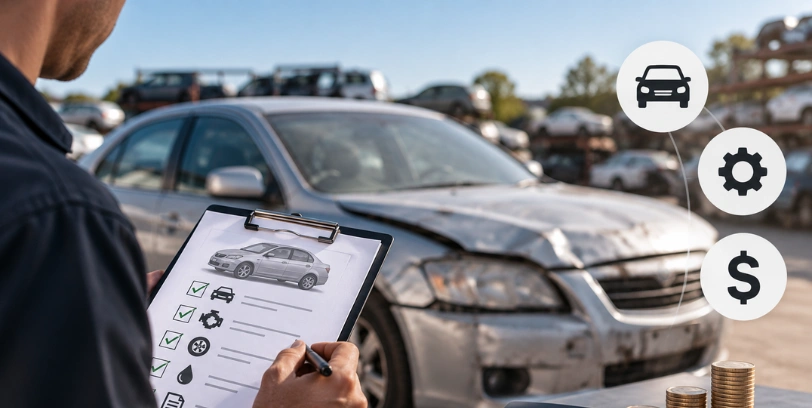
Here is what Zak is actually doing when he walks around your vehicle. Sellers often assume he is hunting for faults. He is verifying four assumptions, in a fixed order.
Minutes One to Two: The Walk-Around
The first pass confirms the vehicle is the one described and checks structural integrity. Panel damage barely registers — dents and scratches change very little once a car is being valued for parts and materials. What matters is whether the chassis rails are straight and whether the vehicle has been in a significant front or rear impact, because structural damage removes onward resale as an option entirely.
Rust receives a quick assessment for location rather than quantity. Surface rust on panels is cosmetic. Rust through the sills, subframe mounting points or floor pan is structural, and it changes which of the three revenue streams below apply.
Minutes Three to Five: Under the Bonnet
The engine bay is the highest-value square metre of most vehicles. The check confirms the engine and gearbox are present and matched to the model, that the battery is fitted, and that major ancillaries — alternator, starter motor, air conditioning compressor, injectors — have not already been removed.
If the vehicle starts, it will be started. Not to assess how well it runs, but to confirm it runs at all. That single fact can move a vehicle between value brackets.
Minutes Six to Eight: Underneath and Inside
Underneath, the catalytic converter is confirmed present. It contains recoverable precious metals and is one of the most frequently stolen components in Queensland, so its absence is checked rather than assumed.
Inside, the check is brief: airbags intact and undeployed, seats and interior trim present, dashboard and electronics not stripped. Interior condition — stains, wear, odour — carries almost no weight. Sellers routinely apologise for a messy interior. It genuinely does not affect the figure.
Where the Money Actually Comes From in Cash for Cars Brisbane Valuations
This is the part almost nobody explains, and it is the reason two vehicles of identical age can attract very different offers.
Every vehicle we buy generates return through one of three routes, and the assessment is essentially deciding which route your car takes.
- Onward resale. The vehicle is roadworthy or economically repairable and can be sold as a running car. This produces the highest offers, and it is why a tired but functional vehicle often beats a newer one with a blown engine.
- Component recovery. The vehicle is dismantled, and viable parts are recovered for the used-parts market. Value here depends almost entirely on how many of that model are still on Queensland roads needing replacement parts.
- Material recovery. The vehicle is depolluted and processed for steel, aluminium and other recoverable materials. This is the floor beneath every offer — the number your car cannot fall below, driven by weight and the prevailing metal rate.
Understanding this explains something that confuses many sellers: a common, popular model in poor condition frequently outperforms a rare model in better condition. Demand for parts follows the roads, not the showroom. It also explains why we can pay for vehicles other buyers decline — see how this applies to scrap vehicles and non-running cars.
Important Read: How to Sell My Car for Cash in Brisbane Without Stress: A Step-by-Step Local Guide
The Five Things That Genuinely Change an Offer on Arrival
An offer should hold. When it legitimately moves, it is almost always one of these:
- A different vehicle than described — wrong build year, wrong variant, or a diesel quoted as a petrol.
- Missing major components — engine, gearbox or catalytic converter already removed but not mentioned.
- Undisclosed structural damage — a significant impact that removes the resale route.
- Access problems — the vehicle is boxed in, behind a locked gate, on soft ground or requires specialist equipment nobody mentioned.
- Ownership complications — finance still owing against the vehicle, or the seller cannot demonstrate they own it.
That last point is worth checking yourself before anyone arrives. You can search the Personal Property Securities Register for a small fee to confirm no finance is recorded against your vehicle.
What Does Not Change Your Offer
Equally useful is knowing what sellers worry about unnecessarily:
- Cosmetic damage — dents, scratches, faded paint, cracked windscreen
- A dirty or damaged interior
- Expired registration, or no registration at all
- No roadworthy certificate
- Flat battery or flat tyres
- Warning lights on the dashboard
None of these requires attention before selling. If you are wondering whether to spend money tidying a vehicle first, our guide on preparing a car for a cash sale in QLD covers what is worth doing and what is wasted effort.
How to Make Sure Your Quote Holds
Three habits protect your number.
Describe the worst first. Lead with the blown head gasket, the missing bonnet, the accident history. A quote built on complete information is a quote that survives contact with the driveway.
Mention access up front. Narrow driveway, steep block, vehicle behind a fence, parked at a mechanic’s yard — all solvable, none expensive, provided the right truck is sent the first time.
Ask what the offer is based on. A buyer working from a real method can tell you which of the three revenue routes your vehicle falls into. A buyer who cannot is quoting a number they have not committed to. Our guide on when not to accept the first cash offer covers this in more detail.
Payment and paperwork are handled at collection. Transfer of ownership is completed through Queensland’s transport department, and we prepare the documentation on the spot.
What Brisbane Sellers Say About the Process
The most common feedback we receive is about the gap between quote and payment being exactly nothing.
“Awesome, on time and easy to deal with.” — Jason H. ★★★★★
“Zak came on time to pick up my car and paid me good money for it as well.” — Sandy H. ★★★★★
“Very helpful service and paid me what I want thanks Zac” — Letissa M. ★★★★★
“Very friendly service. Highly recommend” — Melissa C. ★★★★★
Get a Valuation on Your Vehicle Today
Now that you know how the process works, getting a figure is straightforward. A2Z Car Removals pays up to $9,999 for vehicles across the city, with free collection and payment on the spot. Our cash for cars Brisbane service covers every suburb from the CBD to the outer corridors, and the phone call takes under two minutes.
▸ Call 0435 955 334 — open 6 AM to 8 PM, seven days
▸ Same-day collection available across Brisbane and surrounding regions
▸ Any condition considered — see our full car removal service or sell your car for cash today
Important Read: Ultimate Guide to Cash for Cars Brisbane in 2026: How to Get the Best Price Fast
Frequently Asked Questions
How do professional car buyers calculate vehicle value?
Buyers calculate value in two stages. A desk quote is produced from the vehicle’s make, model, build year, kerb weight, completeness and whether it drives. An on-site inspection then verifies the vehicle matches that description. The underlying figure is determined by which of three revenue routes the vehicle takes — onward resale, component recovery, or material recovery.
Why did I get different quotes from different buyers for the same car?
Because buyers have different outlets. A cash for cars Brisbane operator with a strong used-parts network values a common model higher than a buyer who only processes metal. Quote variation is normal; a buyer who cannot explain the basis of their figure is the one to be cautious of.
Does a dirty or damaged interior reduce my offer?
No. Interior condition carries almost no weight in a cash-for-cars valuation. Stains, wear, odour and damaged trim do not change the figure, so there is no benefit in cleaning a vehicle before collection.
Will my offer be reduced when the driver arrives?
It should not be, provided the vehicle was described accurately. Legitimate adjustments only occur when the vehicle differs from the description — wrong variant, missing engine or catalytic converter, undisclosed structural damage, access problems, or finance owing on the vehicle.
Does my car need registration or a roadworthy certificate to be valued?
No. Neither affects the valuation. Unregistered vehicles and vehicles without a roadworthy certificate are bought routinely across Brisbane. You will need to demonstrate ownership, but the vehicle’s registration status does not change what it is worth.
Is a heavier car always worth more?
Only at the bottom of the range. Weight sets the floor value because material recovery is priced by the tonne. Above that floor, parts demand and resale potential matter far more, which is why a light, popular model can easily outvalue a heavy but unwanted one.
How long does the on-site assessment take?
Around eight minutes. The driver confirms the vehicle’s identity and structure, checks the engine bay and catalytic converter, and completes the paperwork. Payment is made on the spot, and the vehicle is loaded immediately.
Ready for a figure on your vehicle? Call 0435 955 334 or visit A2Z Car Removals for a free, no-obligation quote.
Comments are closed