
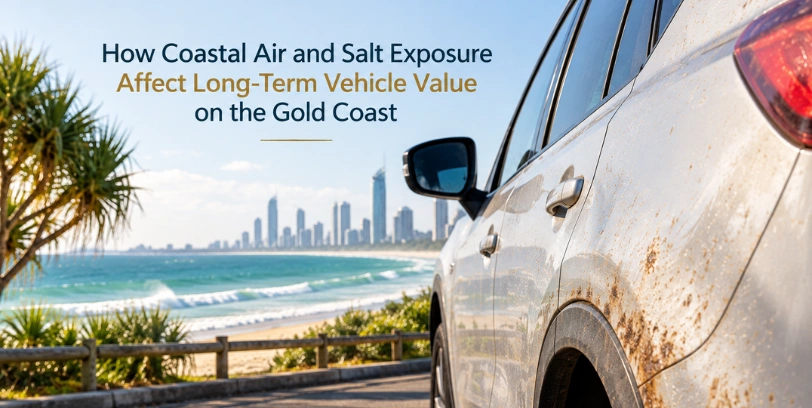
A vehicle parked within a few kilometres of the surf can corrode several times faster than the identical model inland. Queensland’s humidity compounds it, because salt is hygroscopic — it draws moisture out of the air and holds it against metal long after the last rain has dried.
Almost everything written about this topic is preventative advice from detailers: wash weekly, wax often, apply a coating. Useful if your car is new. Considerably less useful if the corrosion has already started and what you actually want to know is what it has cost you. This is about the second question — where salt attacks, what a buyer deducts for each type of damage, and the point at which cash for cars Gold Coast values stop being affected by cosmetic corrosion altogether.
Why Salt Is So Much Worse Than Rain
Rust is a reaction between iron, oxygen, and water. Salt does not cause it — it accelerates it, in two distinct ways.
First, saltwater is an electrolyte. It conducts electricity far better than fresh water, which speeds the electron exchange that drives oxidation. Second, and less appreciated, salt is hygroscopic. Once a salt film has settled on a panel or an underbody seam, it actively pulls humidity from the air and keeps that surface damp. Fresh water evaporates, and the reaction stops; salt residue keeps the reaction running indefinitely.
Add coastal wind carrying fine abrasive sand, which creates microscopic breaches in clear coat, and you have a mechanism that reaches bare metal far sooner than it would inland.
Where Salt Attacks, Ranked by Consequence
Corrosion is not uniform. It concentrates in specific places, and the location matters far more than the quantity when a value is being placed on the vehicle.
Tier One: Structural — Changes Everything
Chassis rails, subframe mounting points, suspension mounting turrets, sill sections, and floor pan. These are load-bearing, and corrosion here is not repairable in any economic sense on an ordinary vehicle.
Structural rust removes onward resale from the equation entirely. A vehicle that would otherwise be sold as a running car becomes a parts-and-materials vehicle, and the offer drops to reflect which value stream now applies. This is the single largest deduction salt exposure can cause.
Important Read: Gold Coast’s Fastest Car Removal – Free Towing & Cash Paid Today
Tier Two: Mechanical — Costs Real Money
Brake callipers and lines, exhaust systems, fuel and brake pipework, suspension components, and electrical connectors.
Coastal vehicles routinely need brake work one to two years earlier than inland equivalents, and seized callipers are a common Gold Coast complaint. Corroded brake lines are a roadworthy failure. Electrical connectors that green up cause intermittent faults that are maddening to diagnose. Each of these is repairable, so the deduction is the cost of repair rather than the loss of the vehicle.
Tier Three: Cosmetic — Barely Registers
Paint bubbling around wheel arches and door bottoms, surface rust on panels, cloudy chrome and trim, faded plastics, and pitted windscreen glass.
This is the damage owners see and worry about, and it is the least consequential of the three. In a private sale it affects presentation and negotiating position. In a cash offer it changes almost nothing, because the value sits in components and weight rather than appearance.
Why Two Neighbours Get Completely Different Outcomes
Owners on the same street, driving the same model, frequently find their vehicles in wildly different condition after a decade. Four variables account for almost all of it.
Garaged Versus Street Parked
This is the largest single factor, and it is not simply about rain. A garaged vehicle spends its overnight hours out of the salt-laden onshore breeze, which is precisely when a street-parked car sits collecting salt film and holding condensation against cold metal. Even an open carport helps, because it interrupts the direct salt deposition that occurs overnight.
Whether the Car Is Driven or Parked
Counterintuitively, a car that sits still often corrodes faster in these conditions than one driven regularly. Movement dries surfaces, keeps brake components working rather than seizing, and prevents moisture pooling in the same spots indefinitely. A vehicle left standing for months on a coastal block is in a worse position than one doing daily kilometres.
Beach Driving and Boat Ramps
Direct saltwater contact is in a different category to airborne exposure. Driving on sand, reversing a trailer down a ramp, or launching a boat immerses the underbody, exhaust, and brake components in salt water. A handful of ramp launches without a thorough freshwater rinse afterwards will do more damage than a year of ordinary coastal parking.
Original Factory Protection
Manufacturers apply differing standards of underbody sealing and galvanising, and it varies markedly by brand and era. Some vehicles from the 1990s and early 2000s are notably vulnerable in coastal conditions, while others of the same vintage hold up remarkably well. This is largely outside an owner’s control, but it explains why identical care produces different results across models.
Important Read: Car Removal Gold Coast – Instant Cash, No Hassle, Free Pickup!
What a Buyer Actually Deducts
Translating the tiers into a valuation is straightforward once you know the logic.
- Cosmetic corrosion only: negligible deduction on a cash offer, moderate in a private sale where appearance drives price.
- Mechanical corrosion: deducted at roughly the cost of the repairs needed to make the vehicle serviceable, if the vehicle is otherwise resaleable.
- Structural corrosion: the vehicle moves value streams. It is no longer priced as a car and starts being priced as recoverable content — engine, gearbox, catalytic converter, panels, wheels, and steel.
This is why two Gold Coast cars of the same age and model can attract very different offers. The one with bubbled arches and a clean underbody outperforms the one with immaculate paint and a rotten sill, every time.
How to Check Your Own Vehicle in Ten Minutes
You can assess which tier your car sits in without any equipment beyond a torch and something to kneel on.
Start at the sills, the sections running beneath the doors between the wheel arches. Press firmly along them. Solid steel resists; corroded steel flexes or crumbles. Then check the inner wheel arches, particularly the rear ones, where salt and grit accumulate and stay damp.
Look underneath at the chassis rails running front to back, and at the points where suspension components mount to the body. Surface discolouration is normal and expected on any coastal vehicle. What you are looking for is flaking that lifts away in layers, or metal that has visibly thinned.
Finally, open the boot and lift the spare wheel well cover. Water collects there, and it is one of the first places structural corrosion appears on coastal cars. If the well holds moisture or shows perforation, the floor pan is compromised.
When Protection Stops Paying For Itself
Preventative maintenance is genuinely effective, but it is an investment, and investments have a break-even point.
On a newer vehicle, regular underbody rinsing and a decent protective coating comfortably return their cost by preserving both mechanical condition and resale value. On a coastal car worth a few thousand dollars with Tier One corrosion already present, rust treatment, sill repair, and coating will cost more than the increase in value they produce. The metal that has gone cannot be restored, only slowed.
At that stage, the rational move is to sell rather than spend. A wrecked or heavily corroded vehicle still holds meaningful value in its components, and structural rust does not prevent collection. If yours has reached that point, our Gold Coast service covers the full coastal strip.
Gold Coast Suburbs Where This Bites Hardest
Exposure scales with proximity to open water and prevailing wind. Vehicles kept at Surfers Paradise, Main Beach, Broadbeach, Mermaid Beach, Palm Beach, Currumbin, Coolangatta, and Southport sit in the harshest band, particularly those parked outdoors within a few streets of the beachfront.
Move inland to Nerang, Mudgeeraba, Robina, or the hinterland and the rate drops noticeably. It does not disappear — sea breezes carry salt several kilometres — but a garaged car at Mudgeeraba will comfortably outlast an identical one parked on the street at Mermaid Beach.
What Gold Coast Sellers Say
“Awesome!! Great to deal with! Will use again!!!” — Lucas Y. ★★★★★
“Very friendly service. Highly recommend” — Melissa C. ★★★★★
“Very quick and reliable” — Logan T. ★★★★★
Get a Figure on Your Coastal Vehicle
Rust does not disqualify a vehicle. We buy corroded, non-running, and structurally compromised cars across the Gold Coast, with free collection and payment up to $9,999 on the spot.
➤ Call 0435 955 334 — 6 AM to 8 PM, seven days
➤ Surfers Paradise to Coolangatta, hinterland included — see cash for cars Gold Coast
➤ Free removal, no roadworthy required — full car removal service
Frequently Asked Questions
How does coastal air affect a car’s value on the Gold Coast?
For a cash for cars Gold Coast valuation, it depends entirely on where the corrosion sits. Cosmetic rust on panels barely changes a cash offer. Mechanical corrosion in brakes, exhaust, and pipework is deducted at repair cost. Structural corrosion in chassis rails, sills, or the floor pan moves the vehicle out of resale and into parts and materials valuation, which is the largest deduction of the three.
How much faster do cars rust near the beach?
Considerably faster than inland equivalents. Salt is hygroscopic, so it holds moisture against metal long after rain has dried, and saltwater conducts far better than fresh water, which accelerates the oxidation reaction. Queensland humidity and coastal heat compound both effects.
Does surface rust reduce what I get for my car?
Very little in a cash sale. Surface rust on panels and bubbling around wheel arches is cosmetic, and cash offers are built from recoverable components and weight rather than appearance. It matters more in a private sale, where presentation influences price.
Where should I check my car for salt damage?
Press firmly along the sills beneath the doors, inspect the inner rear wheel arches, look at the chassis rails and suspension mounting points underneath, and lift the spare wheel well cover in the boot. Flaking that lifts in layers or visibly thinned metal indicates structural corrosion rather than surface rust.
Is it worth rust-proofing an older coastal car?
Only before significant corrosion has taken hold. On a newer vehicle, underbody rinsing and protective coating return their cost. On an older coastal car that already has structural rust, treatment and repair typically cost more than the value they add, because lost metal cannot be restored.
Will you buy a car with structural rust on the Gold Coast?
Yes. For a cash for cars Gold Coast buyer, structural corrosion changes which value stream applies, not whether the vehicle has value. The engine, gearbox, catalytic converter, panels, wheels, and steel content all remain recoverable, and free collection still applies.
Which Gold Coast areas are worst for salt corrosion?
Vehicles parked outdoors near the beachfront at Surfers Paradise, Main Beach, Broadbeach, Mermaid Beach, Palm Beach, Currumbin, Coolangatta, and Southport face the highest exposure. Inland suburbs such as Nerang, Mudgeeraba, and Robina experience noticeably lower rates, though sea breezes still carry salt several kilometres.
Corrosion getting ahead of you? Call 0435 955 334 or contact A2Z Car Removals for a free quote.
Comments are closed