
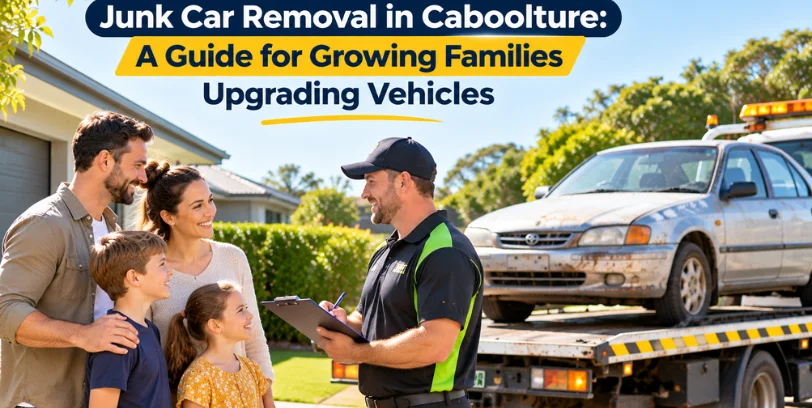
The upgrade is rarely the hard decision. The old car is — and junk car removal Caboolture is usually the cleaner way to finish the job. Families work out what they need next fairly quickly, because the trigger is usually obvious and physical. What takes months longer is deciding what happens to the vehicle the new one replaced, and in that gap the displaced car quietly loses a good deal of what it was worth.
Why the Upgrade Happens When It Does
Family vehicle changes are not gradual. They are triggered by a specific event, and four account for most of them.
The Third Car Seat
The most common trigger by a distance. Three child restraints across a back seat does not work in most sedans and small SUVs, regardless of what the brochure implies. Anchor point positions, seat width, and the sheer bulk of a rearward-facing restraint decide it, and the discovery usually arrives about a month before it is needed.
The Gear Grows Faster Than the Children
A pram and a nappy bag become scooters, sporting equipment, instruments, and eventually a boot that never empties. Families frequently upgrade for luggage space rather than seats, and a wagon or a seven-seater becomes the obvious answer.
Towing Something
A caravan, a boat, a camper, or a box trailer that the current car cannot legally or comfortably pull. This is the trigger that pushes households from a passenger car into a four-wheel drive or a dual-cab ute, and it is common across the Moreton Bay region given how close the water and the hinterland are.
The Current Car Fails at the Wrong Moment
Less planned and more frequent than anyone would like. A major repair quote arrives on a vehicle that was already marginal, and the decision gets made in a week rather than over a year.
What Actually Gets Displaced
Here is the detail that shapes everything else. The car an upgrading family lets go is almost never the worst car in the household.
It is usually the one that was perfectly adequate until last month: the hatchback, the small SUV, or the sedan that did the school run reliably for eight years and simply no longer fits the job. Mechanically it is often fine. It has just been made redundant by a change in requirements rather than by a failure.
That matters, because a vehicle in that condition has real recoverable value, and families routinely underestimate it. The assumption is that an eight or twelve-year-old car with a few hundred thousand kilometres on it is worth nothing. Our guide on high kilometres versus vehicle age covers why that assumption is usually wrong.
The Trade-In Gap
The path of least resistance is to hand the old car to the dealer selling you the new one. It is also, on an older vehicle, usually the weakest option available.
The reason is structural rather than anything sinister. A dealer taking an older vehicle in part exchange has to do something with it. If it is too old or too high in kilometres to retail on their own lot, it goes to wholesale or auction, and the figure they offer you reflects that onward wholesale value minus their handling. On a late-model car with retail appeal, this works out fine. On a twelve-year-old family wagon, it frequently does not.
The practical move is to get both numbers before you commit to either. A trade-in figure and a cash figure take one conversation each, and the comparison is the only way to know which leaves you better off. Our guide on selling versus trading in works through the arithmetic in full.
One caution worth naming. A trade-in figure quoted as part of a new car deal is not always a standalone number, and a generous-looking allowance can be funded by a smaller discount elsewhere in the transaction. Ask what the vehicle is worth on its own.
The Spare Car Trap
The alternative families reach for is to keep the old vehicle as a spare, and it is worth being honest about how that usually goes.
The intention is sound: a second car for the other parent, something to lend out, a backup if the main vehicle is off the road. In practice, a car that has been made redundant by a change in requirements tends to stay redundant. It gets driven occasionally, then rarely, then not at all, and it occupies a driveway or a garage while continuing to cost money.
Registration and compulsory third party cost broadly the same on a low-value vehicle as on an expensive one, so a barely-driven spare consumes a real share of its own worth every year it stays registered. Add insurance, and add the deterioration that comes from standing still, and the spare car is usually the most expensive vehicle in the household per kilometre travelled. Our guide on when an old car costs more to keep sets out the running figures.
None of which means keeping a second car is wrong. It means it should be a decision with a reason behind it rather than a default that happens because nobody made a call.
What a Displaced Family Car Is Worth
A junk car removal Caboolture offer on a vehicle like this is built from three things, and appearance is not one of them.
Parts demand comes first. Family cars are, by definition, common models, which is the single best thing a vehicle can be in this market. Hundreds of the same car are running around Caboolture, Morayfield, Burpengary, and Narangba, and every one of them will eventually need an alternator, a door, or a gearbox. That demand is local and constant.
Completeness comes second. Whether the engine, gearbox, catalytic converter, battery, and wheels are still fitted. The converter is the single largest item on that list by value per kilogram.
Weight comes third and sets the floor. A seven-seater or a wagon carries more recoverable metal than a hatchback, which is why larger family vehicles rarely attract a poor figure even when they are tired. The full calculation is in what determines your car’s cash value.
The Vehicles Changing Hands Around Moreton Bay
The mix in this corridor is fairly consistent, and it is worth knowing where yours sits.
Small and mid-size SUVs replaced by seven-seaters are the largest single category. Sedans and wagons displaced by SUVs come next, and these are often the oldest vehicles in the mix, because they were frequently the household’s second car already. Hatchbacks outgrown by expanding families follow, and finally passenger cars replaced by dual-cab utes when something needs towing.
Accessories on the displaced vehicle are worth mentioning when you ring, because they are valued separately and they are the most commonly forgotten item. Towbars, roof racks, bull bars, and canopies all have independent buyers.
Timing It Properly
The expensive mistake is not choosing the wrong option. It is letting the old car sit for a year while the choice goes unmade.
A vehicle that is still registered, still running, and still complete is worth the most it will ever be worth on the day the new car arrives. From that point, every month it sits adds deterioration and subtracts value: tyres perish, brakes seize onto the discs, the battery dies, fuel degrades, and on a block with any vegetation, rodents find the wiring loom.
The sensible sequence is to settle the question in the same fortnight as the upgrade, while the paperwork is out and the decision is live.
- Get a cash figure before accepting any trade-in allowance, which takes about two minutes on 0435 955 334.
- Ask the dealer what the old car is worth as a standalone number, separate from the new car discount.
- If you are keeping it as a spare, set a date to review that decision rather than leaving it open.
- If you are letting it go, do it while it still starts and rolls, because that is a scheduling advantage rather than a value one.
What Is Not Worth Doing First
Families routinely spend money preparing a displaced car for sale, and almost none of it returns itself on an older vehicle.
Repairs, a roadworthy certificate, renewed registration, a professional detail, new tyres, and a replacement battery all make very little difference to a cash figure, because the value sits in components and weight rather than presentation. A missing key is worth mentioning but is rarely a problem. Our guide covering Bribie Island to Morayfield covers more of the local picture.
Afterwards
If the vehicle was still registered, cancelling the registration and surrendering the plates is your responsibility, and it may recover an unused portion of your registration and CTP. The process is on the Queensland Government website. In Queensland, the plates belong to the registered operator rather than the vehicle, so take them off before the car goes.
What Moreton Bay Families Say
“Zak came on time to pick up my car and paid me good money for it as well.” — Sandy H. ★★★★★
“Excellent, friendly service” — Tricia W. ★★★★★
Clearing the Old Car
Running or not, registered or not, our junk car removal Caboolture service pays up to $9,999 depending on the vehicle, with free collection and payment on the spot before it is loaded.
- Call 0435 955 334 — 6 AM to 8 PM, seven days
- Family cars, wagons, seven-seaters and utes collected — see cash for junk cars
- Caboolture, Morayfield, Burpengary, Narangba and across Moreton Bay — car removals
Frequently Asked Questions About Junk Car Removal Caboolture
Should I trade in the old family car or sell it separately?
Get both figures before committing to either. On a late-model vehicle with retail appeal, a trade-in is often competitive. On an older or high-kilometre family car, the dealer is pricing it as wholesale stock, and a cash figure frequently beats the allowance. Ask what the car is worth as a standalone number rather than as part of the new car deal.
Is my old family car worth anything with high kilometres?
Usually more than owners expect. A junk car removal Caboolture offer is built from parts demand, recoverable components, and weight rather than the odometer. Family cars are common models, which is the best thing a vehicle can be in this market, because repairers and owners nearby need exactly those parts.
Should I keep the old car as a spare?
Only with a reason and a review date. A vehicle made redundant by a change in requirements tends to stay redundant, and registration and CTP cost broadly the same on a low-value car as on an expensive one. A barely-driven spare consumes a real share of its own worth each year, before deterioration is counted.
Do I need to repair or clean the car before junk car removal Caboolture collection?
No. Repairs, a roadworthy certificate, renewed registration, detailing, new tyres, and a replacement battery make very little difference to the figure, because the value sits in components and weight rather than presentation. Spending on any of them before selling rarely returns its cost.
Does a towbar or roof rack add to the offer?
Yes, and they are the most commonly forgotten items at quote time. Towbars, roof racks, bull bars, canopies, and similar fitted accessories have independent buyers and are valued separately. List them when you ring, because an assessor cannot value what they have not been told about.
Is a seven-seater worth more than a hatchback?
At the floor of the range, yes, because weight sets the minimum and a larger vehicle carries more recoverable metal. Above that floor, parts demand matters more, so a common hatchback can comfortably outvalue an uncommon people mover. Both are considered on the same basis.
When is the best time to sell the displaced car?
In the same fortnight as the upgrade. A vehicle that is still registered, running, and complete is worth the most it will ever be worth on the day the new car arrives. Every month it then sits adds deterioration — perished tyres, seized brakes, a dead battery, degraded fuel — and subtracts value.
Upgrading the family car? Call 0435 955 334 or contact A2Z Car Removals for a free quote.
Comments are closed