
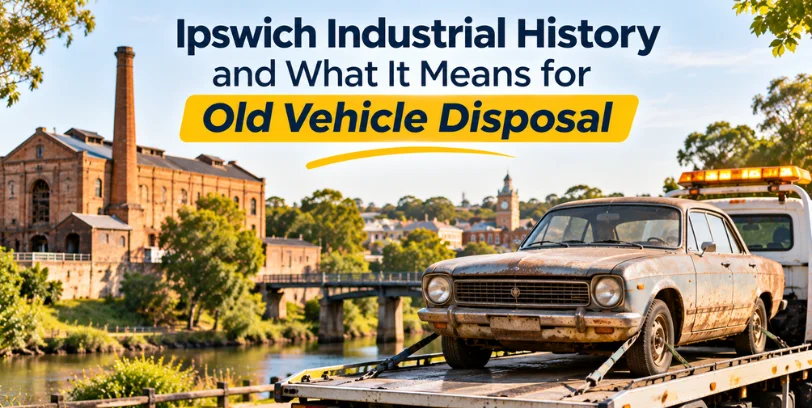
Car removal in Ipswich happens in a city with an older, more mechanically-minded vehicle population than almost anywhere else in South East Queensland, and that is not an accident of taste. It follows directly from what the city was built on: coal, rail engineering, and manufacturing. Industries leave behind more than buildings. They leave behind skills, block sizes, sheds, and habits, and all four show up in the vehicles sitting around the region today.
This matters practically rather than historically. The composition of the local vehicle stock is what drives parts demand, and parts demand is the largest single factor in what an old vehicle is worth here. Anyone arranging a car removal in Ipswich is operating in a market shaped by that history, and it works in their favour more often than not.
The Short Version of the History
Ipswich was one of Queensland’s earliest inland settlements and for a long stretch its most important industrial centre. Coal was mined across the district from the nineteenth century onward. The railway workshops at North Ipswich
Much of that heavy industry has wound down or moved on. The skills, the housing stock built for workers, and the culture of fixing things rather than replacing them did not go with it.
Four Things That History Left Behind
A Population That Repairs Rather Than Replaces
A region that trained fitters and machinists for a century produces households where somebody can weld, somebody has a compressor, and replacing a head gasket is a weekend rather than a quote. That keeps older vehicles on the road years longer than they would survive in a suburb where the first failure means a trade-in.
The visible consequence is an older average vehicle age, and a lot of cars running that would have been retired elsewhere.
Large Blocks and Sheds
Worker housing in the older suburbs came with land, and the newer corridor out toward Ripley and Springfield has not changed that pattern much. A property with a shed and room beside it has somewhere to put a vehicle that is not currently going anywhere.
The practical effect is storage without pressure. In an inner-city terrace, a dead car has to go within weeks because there is physically nowhere for it. In Ipswich it can sit behind the shed for nine years, which is exactly why so many do.
That absence of pressure is worth naming, because it is the reason most of these vehicles are still there. Nothing forces the decision. There is no body corporate notice, no neighbour complaining, no parking fine. The vehicle simply becomes part of the yard, and the cost of leaving it there is invisible while the value inside it quietly declines.
Trade Vehicles in Ordinary Driveways
Industrial and trade employment means utes, vans, and four-wheel drives in domestic numbers rather than commercial ones. These vehicles carry more recoverable weight than passenger cars and usually arrive with fitted accessories — trays, towbars, bull bars, canopies, roof racks — each of which is valued separately.
Deep, Local Parts Demand
This is the one that reaches your wallet. Because so many older vehicles are still running locally, and because a good proportion of their owners do their own work, there is a steady and specific demand for second-hand components in this region.
A wrecker can forecast that an alternator or a gearbox for a common model will sell within weeks to somebody nearby. That forecast is what an offer is built on, and it is stronger here than in regions where older vehicles have already been cleared out.
It is worth understanding what this means in practice. An offer on an end-of-life vehicle is not a sentimental judgement or a round number. It is the sum of what the components are expected to return, minus the cost of collecting, dismantling, and processing the rest. Where the parts are expected to move quickly, that sum is higher. A car removal in Ipswich therefore starts from a stronger base than the same vehicle would attract in a region with no local demand for its components.
Why This Changes What Your Vehicle Is Worth
Three practical consequences follow, and they are worth knowing before you ask anyone for a figure.
The first is that common models do well here. Not just reasonably well — better than rarer vehicles in visibly better condition. Parts demand follows what is still on local roads, so an unremarkable sedan or ute of a popular model frequently outperforms something more interesting that nobody nearby needs components for. The mechanics of that are in what determines your car’s cash value.
The second is that incomplete vehicles are more common here than elsewhere, because a region that repairs its own cars also harvests its own parts. A vehicle that has donated its battery, alternator, starter, and a door to keep another one going is worth a fraction of a complete one, and the line sits at the engine and the catalytic converter. Once those have gone, most of the recoverable value has gone with them. Our guide on whether to part out or sell whole works through where to stop.
The third is that vehicles here have frequently been sitting for a long time, and long-parked cars behave differently. Tyres perish, brakes seize onto the discs, and on a block with vegetation, rodents reach the wiring loom. None of that changes the engine, gearbox, converter, or steel, so it affects how the collection runs rather than what the car is worth.
The Flood Layer
No account of the Ipswich vehicle stock is complete without it. The Bremer River and the creek systems have flooded the region repeatedly, most seriously in 1974, 2011, and 2022, and each event moved a large number of vehicles out of use at once.
Flood-affected cars behave differently from ordinary old ones. Water above the sill line destroys carpet, trim, and the electrical loom, and silt settles where nothing flushes it out. Many are classified as written off. What survives, and survives well, is the engine and gearbox, which are sealed from the water in a way the interior is not. Our guide on flood-damaged cars covers the position in more detail.
If a vehicle on your property went through one of those events and never came back into service, it is still worth a phone call. The figure is built from what can be recovered, and a good deal can be.
Why the Local Market Is Better Served Than Most Regions
An industrial history also leaves behind the infrastructure for handling vehicles at the end of their lives, and the Ipswich corridor is well placed for it.
Licensing matters here. Businesses that buy used vehicles to dismantle for parts or scrap in Queensland require a motor dealer wrecker licence, and the requirements are published by the Queensland Government. It is worth asking for a licence number before any vehicle leaves your property, because an unlicensed disposal leaves the trail pointing back to you. The operator types are compared in our guide to car wreckers.
The practical upside of a well-served region is competition for the parts stream, which is what lifts offers. It also means dealership trade-in figures on older vehicles tend to look poor by comparison, which our guide on what to do when a dealership offers too little in Ipswich covers.
Where the Vehicles Are
The older housing suburbs hold the longest-standing vehicles: Booval, Bundamba, Brassall, Raceview, Silkstone, Eastern Heights, Basin Pocket, and North Ipswich. The newer corridor through Springfield, Springfield Lakes, Redbank Plains, Ripley, and Goodna produces more recent cars with the same storage pattern, because the blocks are still generous.
Further out at Rosewood, Karalee, Marburg, and the rural edges toward the Lockyer Valley, properties behave more like farms than suburbs, and several vehicles at one address is the norm rather than the exception. Our guide on selling multiple old cars for cash in QLD covers how that is handled, and the local picture is in cash for cars Ipswich.
What to Have Ready
The region’s particular characteristics produce a short list worth covering in the first call, which takes about two minutes on 0435 955 334.
- What has already been removed from the vehicle, including parts taken years ago by a previous owner.
- Whether the catalytic converter is still fitted underneath, which is the single largest variable.
- How long it has been standing, and whether it still rolls.
- Every fitted accessory — tray, towbar, bull bar, canopy, roof racks — because they are valued separately.
- Whether more than one vehicle is going, since several at one address is a single trip.
What Ipswich Sellers Say
“Great service easy and quick to work with and fair” — Connor K. ★★★★★
“Vey good job zac” — Alejandra T. ★★★★★
Find Out What Yours Is Worth
Running or not, registered or not, complete or picked over. Our car removal in Ipswich service pays up to $9,999 depending on the vehicle, with free collection and payment on the spot.
- Call 0435 955 334 — 6 AM to 8 PM, seven days
- Booval to Rosewood, Springfield to Karalee — see car removals
- Licensed dismantling and compliant processing — car wreckers
Frequently Asked Questions About Car Removal in Ipswich
Why does Ipswich have so many old vehicles still running?
Because the region’s industrial history left behind trade skills and large blocks. A city built on coal mining and railway engineering produced households where repairs are done at home rather than quoted, and properties with sheds and room beside them give a non-running vehicle somewhere to sit indefinitely.
Does that history actually affect what my car is worth?
Yes, and usually in your favour. A large population of older vehicles still running locally creates steady demand for second-hand components, and a car removal in Ipswich offer is built largely on how quickly those parts will sell nearby. That demand is stronger here than in regions where older cars have already been cleared out.
Why does a common car get a better offer than a rarer one?
Because parts demand follows what is still on local roads rather than what is desirable. A wrecker can forecast that an alternator or gearbox for a popular model will sell within weeks to somebody nearby. There is no equivalent local demand for an uncommon vehicle, so its components sit rather than sell.
I have taken parts off the car over the years. Is it still worth selling?
Yes, though the figure depends on what has gone. Small components such as a battery, alternator, or starter are modest individually. The line sits at the engine and the catalytic converter, because once those two have been removed, most of the recoverable value has gone and what remains is largely weight.
Is a flood-affected Ipswich car worth anything?
Usually yes. Water above the sill line destroys the interior and the electrical loom, and many such vehicles are classified as written off, but the engine and gearbox are sealed from the water and commonly survive. Those components, the catalytic converter, the wheels, and the steel all remain recoverable.
Should I check whether a buyer is licensed?
Yes, and it takes a minute. Businesses buying used vehicles to dismantle for parts or scrap in Queensland require a motor dealer wrecker licence. Ask for the licence number and the licensed business name before the vehicle leaves your property, because the trail from an unlicensed disposal leads back to the last recorded owner.
Can you collect several vehicles from one Ipswich property?
Yes, and it works in your favour. Several vehicles at one address is a single trip, which is more efficient per vehicle than separate collections and easier to schedule. This is common out toward Rosewood, Karalee, and the rural edges, so quote them together rather than individually.
Clearing a vehicle in Ipswich? Call 0435 955 334 or contact A2Z Car Removals for a free quote.
Comments are closed