
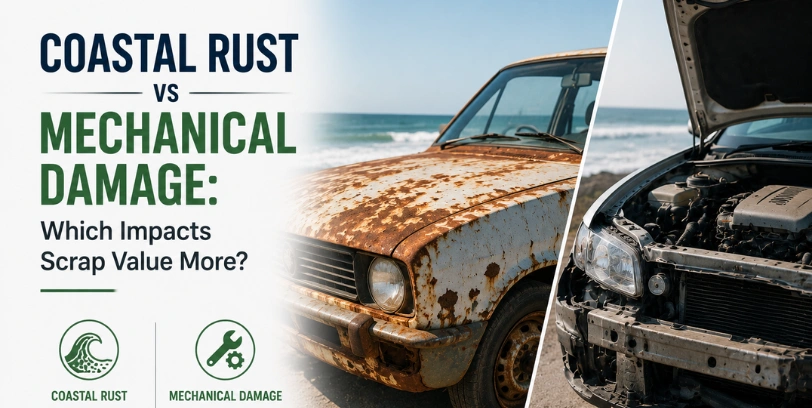
Living on the Gold Coast comes with obvious benefits—the beaches, the lifestyle, the weather. But for vehicle owners, coastal living has a hidden cost: accelerated rust and corrosion. The salt-laden air that blows in from the Pacific doesn’t just affect buildings and outdoor furniture; it actively attacks your vehicle’s metal components, creating deterioration patterns quite different from what you’d see in inland areas.
When it comes to scrap car removal Gold Coast services, vehicle owners often wonder how this coastal rust compares to mechanical damage in terms of scrap value. It’s a reasonable question—if your car has both surface corrosion from years of beachside parking and an engine that’s recently failed, which factor affects your payout more? A2Z Car Removals pays up to $9,999 for Gold Coast vehicles, and understanding how different types of damage affect valuation helps set realistic expectations.
How Coastal Rust Develops on Gold Coast Vehicles
Before comparing rust to mechanical damage, it helps to understand what coastal rust actually involves. The Gold Coast’s proximity to the ocean means vehicles are constantly exposed to airborne salt particles. This salt accelerates the oxidation process that causes rust, creating corrosion that progresses differently—and often faster—than rust in drier inland climates.
Surface rust typically appears first on painted surfaces, manifesting as bubbling paint or orange-brown patches. In coastal areas, this can develop within just a few years on vehicles that are regularly parked outdoors, particularly in areas with direct ocean exposure like Surfers Paradise, Burleigh Heads, or Coolangatta.
Undercarriage corrosion is often more severe because it’s less visible. The underside of Gold Coast vehicles accumulates salt residue from coastal roads, and without regular washing, this salt sits against bare metal components. Exhaust systems, suspension parts, and frame rails are particularly vulnerable.
Structural rust represents the most serious form of corrosion, where oxidation has penetrated deep enough to compromise the vehicle’s structural integrity. This affects critical areas like floor pans, chassis rails, and subframes—damage that’s often hidden until a professional inspection reveals the extent.
Understanding Mechanical Damage and Its Value Impact
Mechanical damage covers a broad category of problems, from minor component failures to catastrophic engine or transmission destruction. Unlike rust, which develops gradually over time, mechanical damage can occur suddenly—a timing belt failure, a collision that damages internal components, or simply the accumulated wear that eventually causes a major system to fail.
Engine failures are among the most common mechanical issues affecting scrap value. A seized engine, blown head gasket, or failed timing chain represents significant damage. However, engines also contain valuable components—alternators, starters, and in some cases the engine block itself—that retain value even when the engine as a whole is non-functional.
Transmission problems similarly affect a vehicle’s operational status without necessarily destroying overall scrap value. A failed automatic transmission makes a vehicle undriveable, but the rest of the vehicle—including the engine if it’s still functional—retains its worth.
Electrical system failures are increasingly common in modern vehicles and can be economically unviable to repair. Computer systems, wiring harnesses, and electronic modules that have failed often cost more to replace than the vehicle is worth—but again, this affects drivability more than scrap value.
The Scrap Value Equation: What Actually Matters
Here’s the insight that many Gold Coast vehicle owners find surprising: scrap car removal services assess value differently than you might expect. The factors that matter most aren’t necessarily the ones that affect daily driving.
Metal weight and composition forms the baseline of any scrap vehicle’s value. A larger vehicle with more steel content is worth more as scrap than a smaller vehicle, regardless of whether either one runs. This base value exists no matter what mechanical or rust damage is present.
Salvageable parts add value above the base scrap rate. This is where the rust vs mechanical damage question becomes relevant. A vehicle with a failed engine but good body panels, interior components, and electrical systems offers more parts value than a vehicle with severe rust that has compromised multiple body panels and structural components.
Catalytic converters and precious metals represent significant value in many vehicles. The platinum, palladium, and rhodium in catalytic converters can be worth hundreds of dollars—and this value is unaffected by either rust or mechanical damage elsewhere in the vehicle.
Coastal Rust: When It Significantly Affects Value
Surface rust—the bubbling paint and orange patches that are cosmetically unpleasant—has minimal impact on scrap value. The metal is still present and still has worth. Professional car removal Gold Coast services factor in the condition of the metal, but surface corrosion doesn’t substantially reduce the overall assessment.
Structural rust is a different matter. When corrosion has progressed to the point where metal has actually been consumed—creating holes in floor pans, weakening chassis rails, or compromising structural integrity—the scrap value does decrease. There’s simply less metal present, and the metal that remains may be lower quality for recycling purposes.
The critical threshold is penetration. Rust that has eaten through panels reduces the total metal weight and may compromise parts that would otherwise be salvageable. A door with surface rust can still be resold; a door with holes rusted through it cannot. This distinction matters more than whether rust is visible on the surface.
Mechanical Damage: When It Significantly Affects Value
Ironically, major mechanical failures often have less impact on scrap value than owners expect. A seized engine is obviously non-functional for driving purposes, but the engine block still contains significant metal. The alternator, starter, and other ancillary components may still work. The rest of the vehicle—body panels, glass, interior, wheels—remains exactly as valuable as before the engine failed.
Mechanical damage that A2Z Car Removals factors into assessments includes:
Fire damage: Vehicles that have experienced engine fires often have heat damage extending beyond the mechanical failure. Melted wiring, heat-warped panels, and destroyed components reduce both parts value and recyclable metal quality.
Flood damage: Salt water flooding—increasingly relevant on the Gold Coast—can cause rapid corrosion throughout the vehicle while simultaneously destroying electrical systems. Fresh water flooding is generally less damaging but still affects value.
Collision damage: Major structural damage from accidents affects the value of body panels and may compromise the frame’s recyclability. Minor accident damage typically has minimal impact on scrap value.
The Verdict: Which Type of Damage Matters More?
For most Gold Coast vehicles, the answer may be neither. Both coastal rust and mechanical damage have less impact on scrap value than owners typically assume. The factors that actually drive value—total metal weight, catalytic converter content, and salvageable parts availability—often remain largely intact regardless of surface corrosion or drivetrain failures.
However, if forced to choose which typically affects value more significantly, severe structural rust generally has a greater negative impact than mechanical damage alone. A vehicle with a failed engine but solid bodywork retains good parts value. A vehicle with extensive rust-through damage has literally lost metal content and often has fewer salvageable parts.
The best approach for Gold Coast vehicle owners is to contact A2Z Car Removals directly for an assessment. Describe both the mechanical condition and the rust situation honestly. Professional assessors can provide an accurate valuation that accounts for your vehicle’s specific combination of issues.
What Gold Coast Customers Say About A2Z Car Removals
“Zak came on time to pick up my car and paid me good money for it as well” — Sandy H. ⭐⭐⭐⭐⭐
“Very quick and easy. Really nice bloke. Highly recommend” — Tamas D. ⭐⭐⭐⭐⭐
“Great service easy and quick to work with and fair” — Connor K. ⭐⭐⭐⭐⭐
Frequently Asked Questions
Does surface rust significantly reduce my car’s scrap value?
Surface rust has minimal impact on scrap value. The metal is still present and recyclable. It’s only when rust has penetrated through panels or compromised structural components that value decreases significantly.
Is a car with a blown engine worth anything as scrap?
Absolutely. A non-running engine doesn’t eliminate the vehicle’s scrap value. The metal content, catalytic converter, and other salvageable parts still have worth. Many vehicles with mechanical failures are worth hundreds or thousands of dollars.
How does salt air damage compare to regular rust?
Salt air accelerates the oxidation process, causing rust to develop faster and spread more aggressively than in inland areas. However, from a scrap value perspective, what matters is the extent of the damage—how much metal has been compromised—rather than the cause.
Should I fix mechanical problems before scrapping my car?
Generally no. The cost of mechanical repairs almost always exceeds any increase in scrap value you’d receive. Professional scrap car buyers assess vehicles based on current condition and factor mechanical issues into their offer.
Do you buy vehicles with both rust and mechanical damage?
Yes. A2Z Car Removals purchases vehicles in any condition—running or not, rusted or pristine. We provide fair assessments based on what each vehicle is actually worth.
What vehicles are affected most by coastal corrosion?
Vehicles parked regularly within a few hundred metres of the ocean experience the most aggressive salt exposure. Older vehicles without modern rust protection coatings are particularly vulnerable. Regular undercarriage washing can slow corrosion but not eliminate it.
Get an Honest Assessment for Your Gold Coast Vehicle
Whether your car has coastal rust, mechanical problems, or both, A2Z Car Removals provides fair, honest assessments. We pay up to $9,999 cash for Gold Coast vehicles, with free removal and same-day service is often available.
✓ All conditions accepted — rust, mechanical damage, or both
✓ Honest valuations — no hidden fees or last-minute changes
✓ Free removal — we come to you anywhere on the Gold Coast
✓ Cash on the spot — paid immediately at pickup
Call 0435 955 334 today for your free quote. We’re available 6 AM to 8 PM, 7 days a week.
Comments are closed