
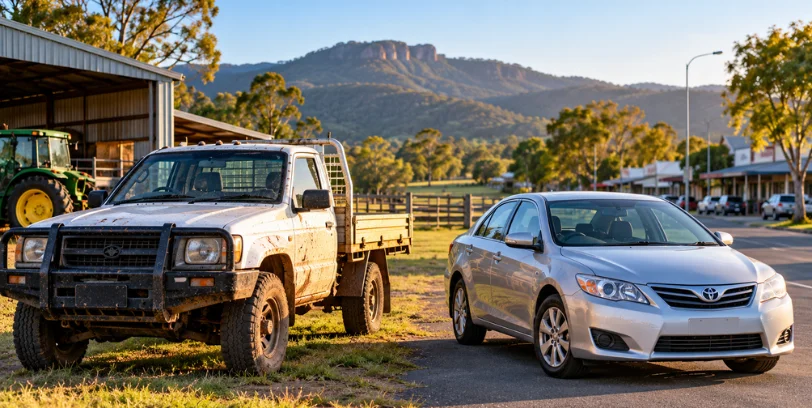
Put a dented, dusty, twenty-year-old farm ute alongside a tidy sedan of the same age with half the kilometres, and most owners would predict the sedan is worth more. In the Scenic Rim, it frequently is not.
This runs against instinct, and it catches out a lot of people selling up or clearing a property. The reasons are specific rather than sentimental, and they cut both ways — some farm vehicles substantially outvalue their road-going equivalents, while others are worth markedly less. Anyone weighing cash for cars Beaudesert options on a mixed collection of vehicles should know which is which.
Round One: Parts Demand
Farm vehicle. Rural Queensland runs on a narrow set of models — HiLux, Land Cruiser, Navara, Triton, Ranger, and older Falcon and Commodore utes. Every one of those has hundreds of working examples within an hour of Beaudesert, all of them needing parts. Demand for their components is constant and local.
Daily driver. A mid-size sedan has fewer local counterparts and competes with a well-supplied market. Its parts move more slowly.
Result: farm vehicle, comfortably. This is the single largest factor, and it explains most of the counterintuitive outcome.
Round Two: Weight and Materials
Farm vehicle. A dual-cab four-wheel drive with a steel tray, bull bar, and towbar carries considerably more recoverable metal than a passenger car. Once a vehicle drops to materials value, weight sets the floor, and a work ute’s floor sits well above a sedan’s.
Daily driver. Modern sedans use more aluminium and composite, which reduces the ferrous weight even where overall mass looks similar.
Result: farm vehicle again.
Round Three: Accessories and Fit-Out
Farm vehicle. Steel trays, bull bars, towbars, dual battery systems, long-range tanks, canopies, winches, snorkels, and roof racks all hold independent resale value. Owners routinely forget these are separate items rather than part of the vehicle. A serviceable steel tray or a decent bull bar has its own buyer regardless of what happens to the ute beneath it.
Daily driver. Factory alloy wheels and a tow bar, generally. Little else.
Result: farm vehicle, decisively. This is the category most frequently underestimated at quote time, so mention every accessory when you call.
Round Four: Structural Condition
Farm vehicle. Here the advantage reverses. Years of paddock work, corrugated tracks, creek crossings, and towing beyond sensible limits take a toll on chassis rails, suspension mounting points, and the tray’s mounting hardware. Fertiliser and chemical residue accelerate corrosion aggressively, and a ute that has carried super or stock feed for a decade often has a chassis in far worse condition than its bodywork suggests.
Daily driver. Sealed roads, garage parking, and no chemical exposure. Structurally, it is usually in better shape.
Result: daily driver takes this one.
Round Five: Documentation and Registration
Farm vehicle. Frequently unregistered for years, sometimes decades, and occasionally without clear ownership paperwork if it came with the property or changed hands informally between neighbours. This does not reduce the vehicle’s value, but it can complicate a sale until ownership is demonstrated.
Daily driver. Usually registered, or recently so, with a clean paper trail.
Result: daily driver, on convenience rather than value.
The Verdict
Three rounds to two in favour of the farm vehicle, and the two rounds it loses are worth less than the three it wins.
Parts demand and weight together account for the majority of any end-of-life valuation, and the farm vehicle leads decisively on both. Accessories add a layer the sedan simply does not have. Structural condition matters, but it reduces the farm vehicle’s advantage rather than erasing it, because a corroded chassis does not diminish the value of the engine, gearbox, differentials, tray, or bull bar.
The practical conclusion for anyone clearing a Beaudesert property: do not assume the tidiest vehicle in the shed is the most valuable one. It frequently is not.
Four Things That Genuinely Sink a Farm Vehicle’s Value
Farm vehicles are not automatically worth more. Four specific problems undercut them, and all four are common.
- Chemical contamination. A tray or cabin saturated with herbicide, pesticide, or fuel residue creates a handling problem for whoever processes the vehicle. Declare it, because it affects how the vehicle is treated rather than whether it is bought.
- Cannibalisation. The most common issue by far. A ute that has donated its battery, alternator, starter, wheels, and seats to keep another vehicle running is worth a fraction of a complete one. Parts removed for reuse elsewhere are parts no longer in the vehicle being valued.
- Ground contact over years. A vehicle that has sat in the same paddock for a decade sinks, and the underside corrodes from persistent ground moisture. It also becomes considerably harder to recover, which is an access issue worth flagging when booking.
- Fire damage. Grass fires and burn-offs reach vehicles more often than people expect on rural blocks. Heat destroys wiring looms, seals, plastics, and the temper of structural steel, which removes most of the parts’ value at once.
What About Tractors, Trailers and Machinery?
Rural properties rarely hold only cars, and the same valuation logic extends to the rest of the shed with a few adjustments worth knowing.
Tractors and Implements
Old tractors are extremely dense in ferrous metal, which puts a high floor under them even when seized solid. Cast iron blocks, heavy transmissions, steel wheels, and counterweights all contribute. Where a tractor is a common model still working on properties nearby, its parts demand can be stronger than any car’s, because agricultural machinery stays in service for decades and owners actively hunt for components.
Trailers, Tippers and Stock Crates
Steel trailers hold solid value in materials alone, and running gear — axles, springs, hubs, and couplings — is readily reusable if serviceable. A rusted trailer bed on a sound chassis with good axles is worth more than its appearance suggests.
Trucks and Larger Vehicles
Old farm trucks combine substantial weight with components that remain in demand, particularly diesel engines and gearboxes from models still common in the region. Access is the practical consideration rather than value — a truck that has not moved in fifteen years may need specific equipment to recover, which is worth flagging at the quote stage.
What Falls Outside
Fibreglass hulls, heavily degraded plastics, tyres in bulk, and anything holding significant residual chemical are the awkward items. They are not necessarily refused, but they are handled differently and do not carry the value that metal does. Mention them separately when quoting a property clear-out so the right expectations are set from the start.
Selling Multiple Vehicles From One Property
Clearing a rural block usually means several vehicles at once rather than one, and that changes the economics in your favour.
Collecting four vehicles from a single Beaudesert address costs far less per vehicle than four separate trips, and that efficiency is reflected in what can be offered. If you have a mixed collection — a running ute, two paddock bashers, and a sedan that has not moved in years — quote them together rather than individually. Registration status is irrelevant to the offer, though you will need to demonstrate ownership, and details are available through the Queensland Government.
The same applies to vehicles that no longer run at all. A non-running vehicle or one that has reached scrap condition still holds recoverable value, particularly in the models common around the Scenic Rim.
One further point specific to rural sales. Vehicles that came with a property, or changed hands between neighbours on a handshake years ago, sometimes have no paperwork trail at all. This is common enough in the Scenic Rim that it rarely causes a problem, but it is worth raising early rather than on collection day. Statutory declarations, rates notices showing the property, and prior correspondence can all help establish that the vehicle is yours to sell. Sorting it beforehand avoids a wasted trip for everyone.
Areas We Cover Around Beaudesert
Collection runs throughout the Scenic Rim, including Beaudesert township, Boonah, Jimboomba, Canungra, Rathdowney, Tamborine, Kooralbyn, Veresdale, Gleneagle, and the surrounding rural properties. Long unsealed driveways and paddock access are routine, though it helps to mention ground conditions after heavy rain.
What Scenic Rim Sellers Say
“Vey good job zac” — Alejandra T. ★★★★★
“Very good man” — William T. ★★★★★
“Good fast service thanks guys” — Jayden R. ★★★★★
Clearing Vehicles From Your Property?
Utes, sedans, four-wheel drives, and paddock bashers all considered. Our cash for cars Beaudesert service pays up to $9,999 with free collection, including from rural properties.
▲ Call 0435 955 334 — 6 AM to 8 PM, seven days
▲ Multiple vehicles quoted together — see cash for cars Beaudesert
▲ Unregistered and immobile vehicles collected — full car removal service
Frequently Asked Questions
Are farm vehicles worth more than daily drivers in Beaudesert?
Often yes. Farm vehicles win on parts demand, because rural Queensland runs a narrow set of models with constant local demand for components. They also win on recoverable weight and on accessories such as trays, bull bars, and dual battery systems. Daily drivers win on structural condition and paperwork, which matter less to the final figure.
Does a rusty chassis make my farm ute worthless?
No. Chassis corrosion reduces the vehicle’s value but does not eliminate it, because the engine, gearbox, differentials, tray, bull bar, and other components remain fully recoverable. Structural rust changes which value stream applies rather than whether the vehicle is worth buying.
Do accessories like bull bars and trays add value?
Yes, and they are the most commonly overlooked item at quote time. Steel trays, bull bars, towbars, dual battery systems, long-range tanks, canopies, winches, and roof racks all carry independent resale value. Mention every accessory when requesting a quote.
Can I sell an unregistered farm vehicle in Queensland?
Yes. For a cash for cars Beaudesert offer, registration status does not affect the value of the vehicle or prevent a sale. You do need to demonstrate ownership, which can require some effort if the vehicle came with the property or changed hands informally.
What reduces a farm vehicle’s value the most?
Cannibalisation is the biggest factor — a ute that has donated its battery, alternator, starter, wheels, and seats to keep another vehicle going is worth a fraction of a complete one. Fire damage, chemical contamination, and years of ground contact also reduce value substantially.
Is it better to sell several property vehicles together?
Yes. Collecting several vehicles from one address costs far less per vehicle than separate trips, and that efficiency is reflected in the offer. Quote a mixed collection together rather than individually.
Do you collect from rural properties around Beaudesert?
Yes. Our cash for cars Beaudesert collection covers Beaudesert township, Boonah, Jimboomba, Canungra, Rathdowney, Tamborine, Kooralbyn, Veresdale, Gleneagle, and surrounding rural properties. Long unsealed driveways and paddock access are routine, though ground conditions after heavy rain are worth mentioning when booking.
Clearing the shed or the back paddock? Call 0435 955 334 or contact A2Z Car Removals for a free quote.
Comments are closed