
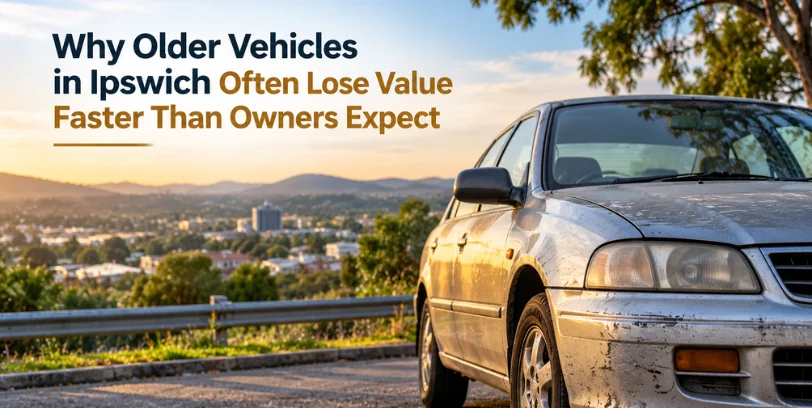
Most owners assume a car loses value gradually, a steady percentage each year until it eventually becomes worthless. That is not how it works. Value falls in steps, not a smooth line, and several of those steps land harder in Ipswich than they do elsewhere in South East Queensland.
Understanding why is genuinely useful, because the drops are predictable. If you can see one coming, you can decide whether to sell before it or accept it. Owners exploring cash for cars Ipswich options are usually reacting to a step they did not see arriving.
Five forces drive it. None of them is depreciation in the textbook sense.
Force One: The Repair Threshold Crossing
This is the sharpest single drop in a vehicle’s life, and it has nothing to do with age.
A vehicle holds ordinary used-car value right up until the moment a repair quote exceeds what the car is worth. At that instant it stops being a used car and becomes a decision. Nothing about the vehicle changed on the day the timing chain let go — but its market did, completely.
For a car worth $4,000, a $4,500 transmission rebuild is that moment. The vehicle drops from four thousand to its recoverable-content value overnight. Owners describe this as the car suddenly being worth nothing, which is not quite right — but the drop is real, and it is instant rather than gradual.
Force Two: The Local Buyer Pool Is Narrower Than You Think
Ipswich has a large, active market for practical used vehicles: utes, wagons, and reliable commuters. What it has considerably less of is demand for older cars with known problems.
A private buyer in Ipswich comparing a $3,000 older vehicle against a $6,000 newer one with finance available will usually take the newer car. The buyer pool for a fifteen-year-old sedan with a warning light is small, and it shrinks further the longer the vehicle sits advertised. Sellers respond by dropping the price, which is the visible symptom of a thin market rather than a reflection of the car itself.
This is why an identical vehicle can command more in a larger market with more buyers. It is not that Ipswich undervalues cars — it is that fewer people are looking for that specific thing at any given moment.
Force Three: Holding Costs Do Not Scale Down
Here is the force most owners overlook entirely, and it is arithmetic rather than opinion.
Registration and CTP cost roughly the same on a $2,000 car as on a $20,000 one. Insurance has a floor. A roadworthy inspection costs what it costs. On a vehicle worth $2,000, twelve months of registration alone can consume a substantial share of its total value. Queensland registration costs and CTP information are published on the Queensland Government website.
The consequence is that an unused older car quietly erodes its own value every month it sits registered and undriven. A vehicle parked for a year while its owner decides what to do has often consumed a meaningful fraction of its worth in the meantime, before any mechanical deterioration is counted.
Force Four: Parts Availability Falls Off a Cliff
Value in older vehicles is tied to parts demand, and parts demand follows how many of that model are still on local roads.
While a model remains common around Ipswich, wreckers want them, repairers want components, and the vehicle holds a floor. Once the population thins past a certain point, demand for its parts collapses and so does that floor. This happens abruptly rather than gradually, and it explains why a model that held its value reasonably for a decade can drop sharply in a couple of years.
It also explains the counterintuitive result many owners encounter: a common, unremarkable car frequently attracts more than a rarer one of similar age, because somebody nearby needs the parts.
Important Read: Reliable Cash for Cars Company in Ipswich – Any Car, Any Condition
Force Five: Deferred Maintenance Compounds
Small deferred jobs do not stay small, and they do not add up in a straight line.
A perished radiator hose left alone becomes a cooling failure, which becomes a warped head. Worn brake pads become scored rotors and then a seized calliper. Each deferral converts a modest job into a larger one, and beyond a certain point the accumulated list crosses the repair threshold from Force One — which is where the sharp drop happens.
Owners rarely notice this compounding while it is occurring, because each individual decision to postpone seems reasonable at the time.
The Timing Question: When Do the Steps Actually Land?
If value falls in steps rather than a straight line, the practical question becomes when to expect each one. The pattern is reasonably predictable across the western corridor.
The First Step: Warranty Expiry
Around the three to five year mark, the vehicle loses manufacturer backing and buyers begin pricing in future repair risk. This drop is modest and well understood, and most owners are not surprised by it.
The Second Step: The Finance Cutoff
Somewhere around eight to ten years, most lenders stop financing the vehicle. This matters more than owners expect, because a large share of used car buyers rely on finance. When a car falls outside that bracket, its buyer pool shrinks to cash purchasers only, and the price adjusts to match. Nothing about the car changed; its available market did.
The Third Step: The Parts Population Collapse
Typically twelve to eighteen years, depending on how many of that model sold locally. Once the number still running around Ipswich falls below the point where repairers and wreckers actively want components, the floor beneath the vehicle’s value drops. High-volume models reach this much later than low-volume ones, which is why a common car outlasts a rare one in value terms.
The Final Step: The Repair Threshold
This one has no fixed timing, because it is triggered by an event rather than a date. It can arrive at eight years or at twenty. What determines its severity is how far the vehicle has already travelled down the previous three steps — the lower the value when the fault arrives, the smaller the repair needed to cross the line.
A car at $12,000 absorbs a $3,000 repair without difficulty. The same $3,000 repair on the same car at $2,500 ends its life as a road vehicle. The repair did not change; the threshold moved beneath it.
The Ipswich Pattern
Put together, the sequence is remarkably consistent across the western corridor.
A vehicle passes ten to twelve years old and small faults begin appearing. Repairs are deferred because the car still runs. Registration renews once or twice on a vehicle that is barely driven. A larger fault finally arrives, the quote exceeds the vehicle’s value, and the owner discovers the car is worth far less than they assumed — because four of the five forces have been operating the whole time quietly.
The practical lesson is that the value drop is not caused by the final breakdown. It was already largely spent. We cover the underlying mechanics in our guide on what determines your car’s cash value, and the repair-versus-sell arithmetic in when a repair bill makes selling the better option.
What to Do About It
Three practical responses, depending on where your vehicle sits.
- If it still runs and is registered, that combination is worth more than most owners realise. Selling before the next major fault captures value that disappears the moment something significant fails.
- If it is off the road and unregistered, stop paying to hold it. An unregistered, undriven car costs money to keep and gains nothing by waiting. Registration status does not affect a cash offer.
- If a repair quote has arrived, get a sale figure before authorising the work. Comparing the two is the only way to know which leaves you better off, and on older vehicles the comparison frequently surprises people.
Areas We Cover Around Ipswich
Collection runs across the whole Ipswich region, including Booval, Bundamba, Goodna, Redbank Plains, Springfield, Brassall, Raceview, Yamanto, Ripley, Rosewood, Karalee, and the surrounding rural areas out toward the Lockyer Valley.
What Ipswich Sellers Say
“Awesome, on time and easy to deal with.” — Jason H. ★★★★★
“Great service easy and quick to work with and fair” — Connor K. ★★★★★
“Good service, very efficient service” — Maria P. ★★★★★
Find Out What Yours Is Worth
Whether it runs or not, registered or not, our cash for cars Ipswich service pays up to $9,999 with free collection and payment on the spot.
■ Call 0435 955 334 — 6 AM to 8 PM, seven days
■ Booval to Rosewood, Springfield to Karalee — see cash for cars Ipswich
■ No repairs or roadworthy needed — sell my car for cash or view our car removal service
Frequently Asked Questions
Why do older vehicles in Ipswich lose value faster than owners expect?
Because value falls in steps rather than gradually. Five forces drive it: crossing the repair threshold, a narrow local buyer pool for older cars, holding costs that do not scale down with value, parts demand collapsing once a model thins out locally, and deferred maintenance compounding into larger faults.
Does registration status affect what I get for an older car?
Not for a cash for cars Ipswich offer. Registration does not change the recoverable value of the vehicle. It does matter for a private sale, where a registered car appeals to more buyers, but continuing to pay registration on an undriven vehicle costs more than it preserves.
Is it worth repairing an older car in Ipswich before selling?
Usually not, once the repair quote approaches the vehicle’s value. Get a sale figure alongside the repair quote and compare the two. On vehicles over ten years old, the repair rarely returns its cost in additional sale price.
Why is my car worth less than the same model advertised online?
Advertised prices are asking prices, not achieved prices, and they reflect vehicles in running order with registration. A car with a known fault sits in a much smaller buyer pool, which is what drives the real difference rather than the model itself.
Do you collect from all Ipswich suburbs?
Yes. Our cash for cars Ipswich collection covers Booval, Bundamba, Goodna, Redbank Plains, Springfield, Brassall, Raceview, Yamanto, Ripley, Rosewood, Karalee, and the surrounding rural areas toward the Lockyer Valley.
Why does a common car sometimes get a better offer than a rare one?
Because parts demand follows how many of that model are still on local roads. A common vehicle has repairers and owners nearby needing its components, which supports a floor under its value. A rarer model of similar age often has no such demand.
How much does holding an unused car actually cost?
Registration and compulsory third party insurance cost broadly the same regardless of the vehicle’s value, so on a car worth a couple of thousand dollars, twelve months of registration alone can consume a significant share of its worth without the car being driven at all.
Ready to find out what yours is worth? Call 0435 955 334 or contact A2Z Car Removals for a free quote.
Comments are closed