
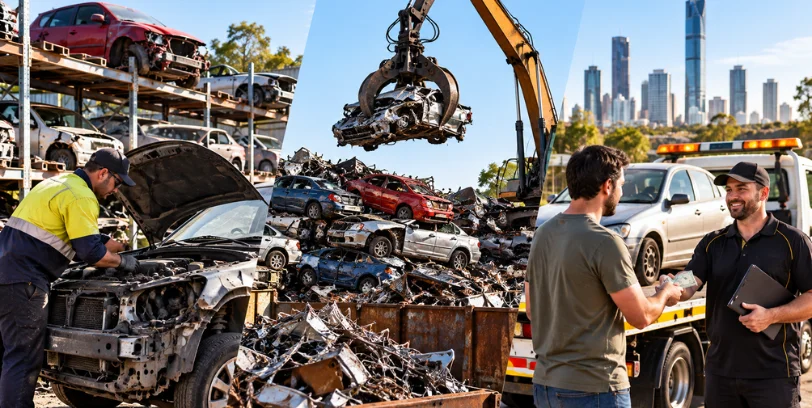
Three businesses will all take your old car away and hand you money. They are not the same thing, they are not regulated the same way, and the difference decides what you get paid.
Most comparisons of this kind describe the service — who tows faster, who pays sooner. That misses the point. The real distinction in Queensland is legal: what each operator is licensed to do with your vehicle once it leaves. That determines which value streams they can access, and therefore what they can afford to offer. A licensed car wreckers QLD business and a scrap metal merchant are operating under different rules entirely.
If you only want the practical service comparison between two of these, our earlier guide on car wreckers versus cash for cars covers it. This piece is about the licensing, and why it matters to your payout.
The Three Operator Types
Car Wreckers, or Auto Dismantlers
A car wreckers QLD business buys end-of-life vehicles to dismantle them, recovers serviceable components, sells those into the used-parts market, and sends the remaining shell for material recovery.
In Queensland, breaking up a vehicle is a regulated activity. Businesses that buy used vehicles to dismantle for parts or scrap require a Motor Dealer (Wrecker) licence, issued by the Office of Fair Trading under the Motor Dealers and Chattel Auctioneers Act 2014. Suppliers of separated parts are additionally regulated as second-hand dealers.
The commercial consequence is that a wrecker has access to all three value streams — resale, component recovery, and materials. That is the widest possible base from which to make you an offer.
Scrap Yards, or Scrap Metal Merchants
A scrap yard buys material by weight. Vehicles are one input among many, alongside industrial offcuts, appliances, and construction metal.
A pure metal merchant is not primarily a vehicle business. They may not dismantle at all, and if they do not, the parts value in your car is simply not something they can pay for. Their offer is weight multiplied by the prevailing rate, minus their handling cost.
This is why a scrap yard is often the lowest offer on a complete, common vehicle, and why it can occasionally be competitive on a stripped shell where no parts value remains anyway.
Cash for Cars Services
The least precisely defined of the three, because it describes a customer-facing model rather than a licensed activity. A cash for cars business buys vehicles directly from the public, collects them, and pays on the spot.
What matters is what sits behind it. Some are licensed wreckers using a consumer-friendly name for the same operation. Others are intermediaries who buy from you and on-sell to a wrecker or scrap yard, taking a margin in between. The first can pay you what a wrecker pays. The second, by definition, pays less than the wrecker they sell to.
Why This Changes Your Offer
Put the three side by side on the same vehicle — a common ten-year-old sedan, complete, not running.
- The wrecker values the engine, gearbox, alternator, starter, catalytic converter, panels, and wheels as saleable parts, then adds the shell’s material value. Widest base, strongest offer.
- The scrap yard values the kerb weight against the day’s metal rate. Narrow base, lowest offer, and the parts simply do not enter the calculation.
- The intermediary values what a wrecker will pay them, less their margin and collection cost. By construction, below the wrecker’s number.
The gap widens on common models with strong local parts demand and narrows on rare models nobody needs components for. We set out how those streams actually work in our breakdown of what determines your car’s cash value.
Where the Boundaries Blur
The three categories are cleaner in law than in practice, and a few overlaps are worth understanding before you start comparing quotes.
Wreckers That Also Run a Metal Operation
Larger operations dismantle and process metal under one roof. This is generally the best position for a seller, because both streams are internal and neither has a margin taken out of it before the offer reaches you.
Important Read: How to Get Cash for Cars Brisbane Without a Roadworthy
Scrap Yards That Have Added Vehicle Buying
Metal merchants have increasingly moved into vehicle purchasing, and some are properly licensed for dismantling while others accept vehicles purely as material. Two businesses that look identical from the roadside can be operating quite differently, which is exactly why the licence question is worth asking.
Brokers and Lead Generators
Some websites offering an instant quote are not buying anything at all. They collect your details and sell the lead to an operator who then contacts you. The clue is usually a quote that arrives without anyone asking about the vehicle’s condition or location in any detail, followed by a call from a business with a different name.
None of these arrangements is improper in itself. The point is simply that each additional party between you and the vehicle’s final destination takes a margin, and that margin comes out of your figure.
How to Check a Licence in Queensland
This takes about two minutes and is worth doing before any vehicle leaves your property.
Ask for the licence number and the licensed business name. A licensed operator will give both without hesitation. Reluctance, or an answer along the lines of not needing one, is the end of the conversation.
The requirements for a motor dealer wrecker licence are published by the Queensland Government, and the separate obligations that apply to second-hand dealers are set out in the fair trading legal requirements.
Expect to show identification. A licensed buyer is obliged to verify who they are buying from and to record prescribed details of the transaction. If nobody asks for your identification, that operator is not meeting their obligations, and the absence of a record is a problem for you rather than for them.
Get the paperwork. A signed record of the sale, with the vehicle identified and the date recorded, is your evidence that the vehicle left your possession. Without it, you have no proof of when you stopped being responsible for it.
Why Unlicensed Operators Are Your Problem, Not Theirs
This is the part that rarely gets said plainly.
A vehicle is traceable through its VIN regardless of what happens to it. If an unlicensed operator dumps it, strips it and abandons the shell, or it surfaces somewhere it should not be, the trail leads back to the last recorded owner. Without documentation of the sale, that is still you.
The same applies to registration. If the vehicle remains registered in your name because no transfer or cancellation occurred, tolls and infringements continue to be issued against you. Our guide on what happens when registration has expired for several months covers the exposure in more detail.
There is an environmental dimension too. A licensed operator is obliged to depollute before dismantling — capturing oils, coolant, fuel, and refrigerant. An unlicensed one has no such obligation and no facility to do it.
What Licensing Actually Obliges an Operator to Do
Licensing is not a formality. It carries specific duties, and knowing them tells you what a compliant transaction should look like.
- Verify who they are buying from. A licensed buyer must sight identification and record prescribed details of the seller and the vehicle. If nobody asks, no record exists.
- Keep records of the transaction. Second-hand dealers operate under holding and record-keeping obligations, which exist largely to make stolen goods harder to move through legitimate channels.
- Display the licence. Licensed premises are required to show that a licence is held, which is a straightforward thing to look for if you visit a yard.
- Depollute before dismantling. Oils, coolant, fuel, and refrigerant must be captured rather than released. Refrigerant in particular is tightly controlled.
Queensland Parliament has also been considering further measures aimed at the theft and disposal of stolen scrap metal, which would tighten obligations on second-hand dealers further. The direction of travel in this industry is toward more documentation, not less.
Which Should You Use?
A short decision rule covers most situations.
- Complete vehicle, common model, running or not: a licensed wrecker, every time. The parts stream is where your money is.
- Already stripped, no engine or converter: the gap narrows considerably. Weight is most of what remains, so compare offers directly.
- Roadworthy and registered with real road value: consider a private sale first, since none of these three will match a working car’s market price.
Whichever you choose, the questions are the same: licence number, identification requested, paperwork provided. Vehicles that are broken or in scrap condition are all collected on the same basis.
What Queensland Sellers Say
“Very quick and easy. Really nice bloke. Highly recommend” — Tamas D. ★★★★★
“Very good man” — William T. ★★★★★
Selling to a Licensed Operator
A2Z Car Removals collects across Queensland with free removal, payment on the spot up to $9,999, and documentation completed at collection.
◆ Call 0435 955 334 — 6 AM to 8 PM, seven days
◆ Licensed dismantling and compliant processing — see car wreckers
◆ Brisbane, Ipswich, Gold Coast, Sunshine Coast and regional QLD — car removals
Frequently Asked Questions
What is the difference between car wreckers, scrap yards, and cash for cars in QLD?
A wrecker dismantles vehicles and sells recovered parts, which requires a Motor Dealer (Wrecker) licence in Queensland. A scrap yard buys material by weight and often does not dismantle at all. Cash for cars describes a customer-facing model rather than a licensed activity, so the business behind it may be either a licensed wrecker or an intermediary reselling to one.
Do car wreckers in QLD need a licence?
Yes. Car wreckers QLD businesses buying used vehicles to dismantle for parts or scrap require a Motor Dealer (Wrecker) licence issued by the Office of Fair Trading under the Motor Dealers and Chattel Auctioneers Act 2014. Suppliers of separated parts are also regulated as second-hand dealers.
Who pays more, a wrecker or a scrap yard?
A wrecker usually pays more on a complete vehicle, because they can value the engine, gearbox, catalytic converter, panels, and wheels as saleable parts in addition to the shell’s material value. A scrap yard prices weight alone. On an already stripped vehicle, the gap narrows considerably.
How do I check if a car wrecker is licensed in Queensland?
Ask any car wreckers QLD operator for the licence number and the licensed business name before the vehicle leaves your property. A licensed operator provides both without hesitation, will ask to see your identification, and will give you signed paperwork recording the sale.
What happens if I sell my car to an unlicensed operator?
The risk sits with you rather than them. A vehicle remains traceable through its VIN, so if it is dumped or turns up somewhere it should not be, the trail leads to the last recorded owner. Without documentation of the sale and without a registration transfer or cancellation, that is still you.
Why do cash for cars companies offer different amounts?
Because their outlets differ. A licensed wrecker can pay from the parts stream. An intermediary buys from you and on-sells to a wrecker, so their offer is the wrecker’s figure less a margin. A metal-only buyer can pay for weight and nothing else.
Will a wrecker buy my car if it is complete and running?
Yes, though it is worth considering whether the vehicle still has genuine road value first. If it is roadworthy and registered, a private sale usually achieves more. Once repairs exceed what the car is worth, a licensed wrecker becomes the stronger option.
Selling to a licensed operator? Call 0435 955 334 or contact A2Z Car Removals for a free quote.
Comments are closed