
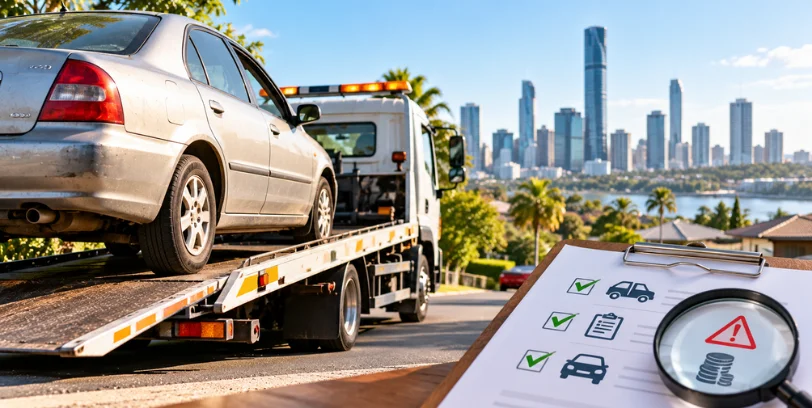
Start with the uncomfortable truth: nothing about car removal is free. Towing costs money, the driver’s time costs money, and the fuel costs money. What “free” actually means is that those costs have been absorbed into the offer rather than charged to you separately.
That distinction matters, because it explains where the problems arise. An operator who has genuinely absorbed the cost quotes you a figure and pays it. An operator who has not will quote a high figure, then find reasons to reduce it once the truck is in your driveway and the vehicle is halfway onto the tray. Every legitimate car removals Brisbane operator works the first way, and the difference is easy to detect before you book if you know what to ask.
If you want the mechanics of how free removal works at all, our guide on free car removal explained covers that ground. This piece is only about the money.
The Seven Charges That Turn Up
These are the deductions that appear in this industry, roughly in order of how often sellers encounter them.
1. The Towing or Collection Fee
The most straightforward one. The vehicle is quoted at a figure, and a towing charge is then subtracted at collection. Sometimes it is disclosed in fine print on a website; more often it appears as a verbal adjustment on the day.
The tell is a quote that arrives without any question about where the vehicle is. An operator absorbing the tow needs to know the location, because distance affects their cost. One who intends to charge you for it does not care where the car is, because you are paying for the distance either way.
2. The Administration or Processing Fee
A flat deduction described as covering paperwork, disposal documentation, or handling. There is genuine administrative work in transferring a vehicle, but it belongs in the operator’s cost base, not as a separate line item taken from your payment.
3. The Winching or Difficult-Access Surcharge
Charged when a vehicle will not roll, sits behind a gate, or needs skates. The work is real, and it does take longer. The problem is timing: a competent operator asks about access at the quote stage and prices it in. One that does not ask, then charges on arrival, has effectively quoted you a number they never intended to pay.
4. The After-Hours or Weekend Loading
A premium applied for collection outside standard hours. Worth clarifying up front simply because “we operate seven days” and “we operate seven days at the same price” are different statements.
Important Read: How Much Is My Scrap Car Worth in Brisbane? Real Insights That’ll Surprise You
5. The Fluid or Environmental Disposal Fee
A deduction for handling oil, coolant, or fuel. Depollution is a legal obligation on the operator and a normal cost of doing business. It is not a service performed on your behalf that you should be invoiced for.
6. The Tyre Disposal Charge
Tyres genuinely carry negative value, meaning a facility pays to dispose of them. That is a real cost, and it is real for every operator equally. Some pass it to you as a line item; most absorb it, because it is a known and predictable cost of accepting any vehicle.
7. The Cancellation or Call-Out Fee
The one that catches people who decline an unexpectedly reduced offer. If the on-site figure drops and you decline, you should be able to walk away owing nothing. Ask this specifically, because it is the fee that turns a bad quote into an actual loss.
What a Genuinely Free Removal Covers
On the other side of the ledger, here is what should be included with no deduction whatsoever:
- Tilt tray attendance at your address, anywhere in the metropolitan area
- Winching, skates, and the equipment needed for a vehicle that does not roll or start
- Loading and transport to the processing facility
- Transfer paperwork completed on site
- Depollution and environmentally compliant processing
- The quote itself, whether or not you proceed
If any of those appears as a deduction, it is not a free removal — it is a paid removal with the fee moved to the end of the transaction.
How the Quote Should Be Built
A useful way to test an operator is to ask how they arrived at the number. A figure built from something can be explained; a figure invented to win the call cannot.
A legitimate quote starts from what the vehicle is worth to the buyer — parts demand for that model, whether it runs, kerb weight against the current metal rate. From that gross figure the operator subtracts their own costs, and collection is one of them. What you are offered is the remainder.
This is why distance affects offers on identical vehicles. A car at Chermside and the same car at Esk are worth the same to a buyer, but they do not cost the same to collect. An honest operator reflects that in the quote itself, which is why regional figures are sometimes lower. A less honest one quotes the metro number everywhere and recovers the difference as a towing charge on arrival.
Both approaches account for the same cost. Only one tells you about it before you commit your morning to it.
Important Read: How to Sell My Car for Cash in Brisbane Without Stress: A Step-by-Step Local Guide
Four Questions That Settle It Before You Book
Ask these on the phone, and the answers will tell you what you need to know in under a minute.
“Is the figure you have quoted the amount I will be handed?” Not “is towing free”, which invites a narrow answer about towing specifically. Ask about the final amount, which covers every possible deduction at once.
“What would change that figure when the driver arrives?” A straight operator will give you a short, specific list: a different vehicle than described, missing engine or catalytic converter, finance owing, undisclosed structural damage. A vague answer here is the warning sign.
“The car has flat tyres and sits behind a gate. Does that change anything?” Ask even if it is not true. You are testing whether access difficulty triggers a surcharge. The answer should be that it affects which truck is sent, not what you are paid.
“If I decline the offer on the day, do I owe anything?” The answer should be an immediate no.
Why Some Operators Work This Way
It is worth understanding the commercial logic, because it explains why the practice persists.
Quoting high wins the phone call. A seller ringing four operators takes the highest number, and by the time the truck arrives they have usually stopped calling around. At that point the vehicle is often already partly loaded, the seller has set aside the morning, and accepting a reduced figure feels easier than starting again.
The correction is simple: treat the on-site offer as the real offer, and be willing to decline it. An operator who quoted honestly will not object, because their figure has not moved.
Where Sellers Most Often Get Caught
Three situations produce the majority of complaints in this industry, and all three are avoidable.
The Regional Pickup
A vehicle outside the metro area attracts a metro-level quote, and the distance is deducted on the day. Sellers in the Lockyer Valley, Scenic Rim, and out toward the Western Downs encounter this most often, simply because the drive is long enough to matter. Always state the actual location when asking for a figure, not just “Brisbane”.
The Vehicle That Has Not Moved in Years
Long-parked cars are the classic surcharge target. Flat tyres, seized brakes, and a vehicle that has settled into soft ground all take longer to recover, and an operator who did not ask about it at the quote stage has an easy justification for reducing the offer once they are standing in front of it.
The Multiple-Vehicle Clear-Out
Several vehicles from one property should reduce the cost per vehicle, since it is one trip rather than four. Occasionally it works the other way, with a per-vehicle collection charge applied to each. Ask specifically how a multiple pickup is priced, because it should be a point in your favour.
The Costs That Are Legitimately Yours
To be fair about it, two costs genuinely belong to you rather than the operator, and neither is a hidden fee.
Registration cancellation is your responsibility, along with returning the plates if you want a refund on any unused portion. The process is set out on the Queensland Government website. Nobody can do this for you, and it is money you recover rather than money you spend.
Finance owing on the vehicle is also yours to resolve. A vehicle with a security interest recorded against it cannot be transferred cleanly, and our guide on selling a car with finance owing in QLD explains the options.
How We Handle It
The quote you are given over the phone is the amount handed to you before the vehicle is loaded. Access difficulty, flat tyres, a vehicle that will not roll, and awkward driveways are our problem to solve rather than yours to pay for. If you decline on the day, you owe nothing. Vehicles across the metro area, Ipswich, and the Gold Coast are collected on the same terms.
What Brisbane Customers Say
“Great service easy and quick to work with and fair” — Connor K. ★★★★★
“Good service, very efficient service” — Maria P. ★★★★★
Book a Removal With No Deductions
Our car removals Brisbane service pays up to $9,999 depending on the vehicle, with the quoted figure paid in full and collection at no charge anywhere we operate.
▸ Call 0435 955 334 — 6 AM to 8 PM, seven days
▸ No towing, admin, winching, or call-out charges — see our car removal service
▸ Any condition, running or not — sell my car for cash or cash for junk cars
Frequently Asked Questions
Is free car removal in Brisbane actually free?
With car removals Brisbane operators, it should be, in the sense that you pay nothing and receive the full quoted amount. The towing cost is real, but a legitimate operator absorbs it into the offer rather than deducting it separately. If any charge is subtracted from your payment at collection, it is not a free removal.
What hidden fees do car removal companies charge?
The seven that appear most often are a towing or collection fee, an administration or processing fee, a winching or difficult-access surcharge, an after-hours loading, a fluid or environmental disposal fee, a tyre disposal charge, and a cancellation or call-out fee if you decline on the day.
What should I ask before booking a car removal?
Ask whether the quoted figure is the amount you will be handed, what specifically would change it on arrival, whether difficult access or flat tyres affect the payment, and whether you owe anything if you decline the offer on the day. Four questions, under a minute, and the answers are revealing.
Can a car removal company reduce the offer when they arrive?
Legitimately, only if the vehicle differs from what was described — a different variant, a missing engine or catalytic converter, undisclosed structural damage, or finance owing. Access difficulty and flat tyres should have been priced in at the quote stage.
Do I have to pay if the car will not start or has flat tyres?
No. Winching, skates, and the extra loading time are part of the service and should not attract a surcharge. Mention the condition when booking so the right equipment is sent, which protects your quote rather than reducing it.
Who cancels the registration after car removals in Brisbane?
You do. After car removals Brisbane collection, registration cancellation and returning the number plates are the seller’s responsibility, and doing so may recover an unused portion of your registration and CTP. This is money back to you, not a fee, and no operator can complete it on your behalf.
Is a free quote really free with no obligation?
It should be. Ask directly whether you owe anything if you decline on the day, because a cancellation or call-out fee is what converts an unexpectedly reduced offer into an actual loss. The answer should be an immediate no.
Want a figure that holds? Call 0435 955 334 or contact A2Z Car Removals for a free, no-obligation quote.
Comments are closed