
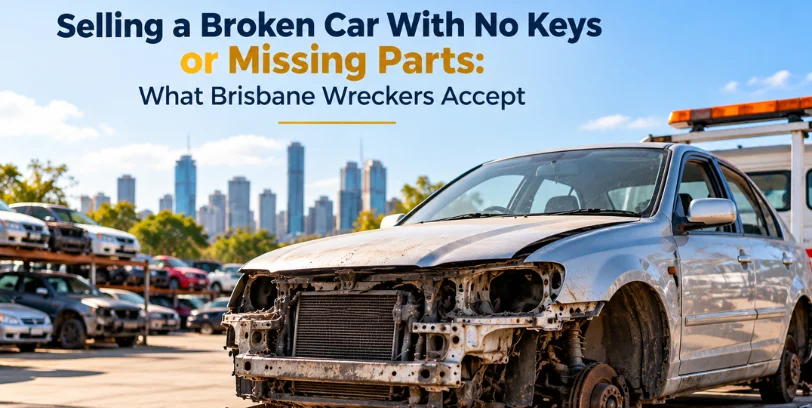
Short answer: almost everything. Missing keys, no engine, stripped interior, wheels gone, sitting on bricks — none of it disqualifies a vehicle from being bought. What changes is the figure, and by how much depends entirely on which items are missing.
Every operator in this industry will tell you they accept vehicles in any condition, which is true and completely unhelpful when you are trying to work out whether yours is worth a phone call. What follows is the specific version: what each missing component actually costs you, what genuinely gives a buyer pause, and how to sell a vehicle when you cannot prove ownership in the usual way. Owners looking at cash for broken cars Brisbane options often have a vehicle worth considerably more than they assume.
Missing Keys: Less Serious Than You Think
Losing the keys feels like a dead end. It is not, and it barely registers on most vehicles.
The reason is that keys matter for one thing: whether the vehicle can be started, moved, and tested, which keeps onward resale open as an option. On a vehicle already beyond economical repair, that option was gone regardless, so the keys are not doing any work.
Where it does count is on a newer vehicle that still runs. Modern keys carry transponders coded to the immobiliser, and replacement requires programming to that specific vehicle. On a car with genuine resale potential, that cost is real, and it will be reflected. On a fifteen-year-old car heading for dismantling, the effect is close to nothing.
Practically, missing keys change how the vehicle is loaded rather than what it is worth. Without keys, the steering may be locked, which means skates and extra time. Mention it when booking so the right equipment arrives.
Missing Parts, Ranked by What They Cost You
This is the useful part. Vehicles arrive stripped for all sorts of reasons — parts sold off, components donated to another car, theft. Here is the impact of each, heaviest first.
Catalytic Converter — the biggest single loss
The converter contains recoverable platinum, palladium, and rhodium, and it is the highest value per kilogram in the vehicle. Its absence is the most significant deduction on this list by a wide margin.
Converter theft is common across Brisbane, and many owners do not know theirs has gone. It is worth looking underneath before you request a quote, because it is far better to mention it than to have it discovered on arrival.
Engine and Gearbox — large, but not fatal
Together these are the bulk of the mechanical value. A vehicle with the engine removed drops substantially, but it does not become worthless: the body shell, panels, wheels, glass, wiring, and remaining components all carry value, and the shell still has weight.
Wheels — moderate, with a loading consequence
Alloy wheels carry real aluminium value; steel wheels less so. The larger issue is practical. A vehicle sitting on brake discs or on blocks needs skates, sometimes a second operator, and considerably more time. Say so at the quote stage.
Important Read: How to Sell My Car for Cash in Brisbane Without Stress: A Step-by-Step Local Guide
Alternator, Starter, Battery, Injectors — small individually
These are ordinary recoverable components. Any one missing is a minor deduction. Several missing together start to add up, and it also signals to an assessor that the vehicle has been picked over, which prompts a closer look at what else has gone.
Doors, Bonnet, Bumpers, Lights — minor
Panels have modest individual value, and it varies with how common the model is. A missing bonnet or bumper is a small adjustment, not a barrier.
Seats, Dashboard, Interior Trim — negligible
Interior components contribute very little. A completely stripped interior changes the figure hardly at all, which surprises owners who assume a gutted cabin looks worse than it costs.
The Cannibalisation Pattern
One scenario comes up constantly and is worth naming: the vehicle that has been kept as a donor.
Somebody owns two of the same model, one stops running, and it becomes a parts source for the other. Over a year or two, the battery, alternator, starter, wheels, and a door go across. Each transfer was sensible individually. Collectively, the donor is now worth a fraction of what it was.
If you are heading down that road, it is worth knowing where the line sits. Once the converter and the engine have gone, most of the recoverable value has gone with them. Our guide on whether to part out or sell a car whole works through that arithmetic, and how broken a car can be before selling for cash covers the lower boundary.
How to Describe a Stripped Vehicle Accurately
Accuracy at the quote stage is what protects your figure, and stripped vehicles are the hardest to describe because owners genuinely lose track of what has gone.
Walk around it once with a torch and check five things in order: is the engine still in it, is the gearbox attached, is the catalytic converter present underneath, are all four wheels fitted, and does the bonnet still open? Those five answers cover the great majority of the value.
Then add anything you know has been removed, even if you cannot see the gap. Parts sold two years ago, components donated to another vehicle, items taken by whoever had the car before you. An assessor will find them on arrival regardless, and a quote built on the complete picture is a quote that holds.
The one thing worth avoiding is optimism about parts you intend to remove later. If you are planning to pull the wheels off before collection, quote it without the wheels.
Proving Ownership Without Keys or Papers
This is the genuine obstacle, and it is not the vehicle’s condition.
A licensed buyer must verify that you have the right to sell the vehicle. That protects you as much as them, because a properly recorded sale is your evidence that the vehicle left your possession. The usual route is the registration certificate plus photo identification, but plenty of long-parked vehicles have neither.
If the vehicle is or was registered to you, your identification plus the registration record is usually sufficient, even where the paper certificate is long gone and the registration lapsed years ago.
If it came with a property you bought, this is common on acreage and rural blocks. A statutory declaration setting out how the vehicle came to be in your possession, supported by documents showing you own the land, is the normal path.
If it was inherited, the estate paperwork governs it. Our guide on selling an inherited car legally in QLD sets out what is required.
In every case, run the VIN through the Personal Property Securities Register first. A search costs a couple of dollars and confirms whether finance is recorded against the vehicle or whether it is on the written-off register. Outstanding finance is the one thing that genuinely stops a sale, and it is far better to find out beforehand.
Vehicles That Have Not Moved in Years
A stripped car and a long-parked car are usually the same car, and standing still creates its own set of issues worth flagging when you book.
Tyres perish and go flat, which is a loading consideration rather than a value one. Brake components seize onto the discs, so a vehicle that rolled fine three years ago may not roll now. On semi-rural blocks, rodents reach wiring looms and insulation, which does reduce recoverable value where the loom is destroyed.
The vehicle may also have settled. A car parked on grass or soil for a decade sinks, and vegetation grows through and around it. Neither prevents collection, but both add time and occasionally require different equipment, so they belong in the initial conversation rather than being discovered on the day.
Registration will almost certainly have lapsed, which does not affect the offer at all. It does mean the vehicle should not be left on a public street, since councils across Brisbane can act on unregistered vehicles on roadways.
What Actually Gives a Buyer Pause
For completeness, the short list of things that are a real problem, none of which is about missing parts:
- Finance owing against the vehicle, which must be cleared before it can change hands.
- No demonstrable ownership at all, with no registration history, no property link, and no estate documentation.
- A missing or tampered VIN, which prevents identification of the vehicle entirely.
- Access that was never disclosed — a vehicle sunk into soft ground, grown into vegetation, or behind a structure built after it was parked.
Condition is not on that list, and neither is anything that has been removed from the car.
Important Read: Sell Your Broken Car for Cash Now—Pickup Within 24 Hours!
What Brisbane Sellers Say
“Earlier pick up, very helpful & polite” — Stacey M. ★★★★★
“Very quick and reliable” — Logan T. ★★★★★
Get a Figure on a Broken or Stripped Vehicle
No keys, no engine, no wheels, no registration — all considered. Our cash for broken cars Brisbane service pays up to $9,999 depending on what remains, with free collection and payment on the spot.
■ Call 0435 955 334 — 6 AM to 8 PM, seven days
■ Non-runners and stripped shells collected — see cash for broken cars
■ Skates and winching at no charge — car removals or cash for wrecked cars
Frequently Asked Questions
Can I sell a car with no keys in Brisbane?
Yes. For cash for broken cars Brisbane buyers, a vehicle beyond economical repair loses almost nothing from missing keys on the figure, because the resale option they preserve was already gone. They do affect loading, since the steering may be locked, so mention it when booking and the right equipment will be sent.
What missing part reduces a broken car’s value the most?
The catalytic converter, by a wide margin. It contains recoverable platinum, palladium, and rhodium and carries the highest value per kilogram in the vehicle. The engine and gearbox together are the next largest, followed by wheels, then smaller components such as the alternator and starter.
Will wreckers buy a car with no engine?
Yes. Cash for broken cars Brisbane operators buy engineless vehicles routinely. The deduction is substantial, but the body shell, panels, wheels, glass, wiring, and remaining components all hold value, and the shell still has weight. A vehicle with the engine removed is bought routinely across Brisbane.
Does a stripped interior reduce what I get?
Barely. Seats, dashboard, and trim contribute very little to a cash valuation. A completely gutted cabin looks far worse than it costs, and it is not a reason to avoid requesting a quote.
How do I sell a car when I do not have the registration papers?
You need to demonstrate the right to sell rather than produce a specific document. If the vehicle was registered to you, identification plus the registration record is usually enough. If it came with a property, a statutory declaration supported by land ownership documents is the normal path. Inherited vehicles are governed by the estate paperwork.
Should I check the PPSR before selling a broken car?
Yes. A search costs a couple of dollars and confirms whether finance is recorded against the vehicle or whether it appears on the written-off register. Outstanding finance is the main thing that genuinely stops a sale, so it is far better to find out beforehand than on collection day.
Is it better to strip parts myself or sell the car whole?
It depends where you stop. Removing a few small components has a modest effect. Once the catalytic converter and engine have gone, most of the recoverable value has gone with them, and what remains is largely weight. If you are selling parts individually, quote the vehicle on the basis of what will actually still be in it.
Not sure if yours qualifies? Call 0435 955 334 or contact A2Z Car Removals for a free quote.
Comments are closed