
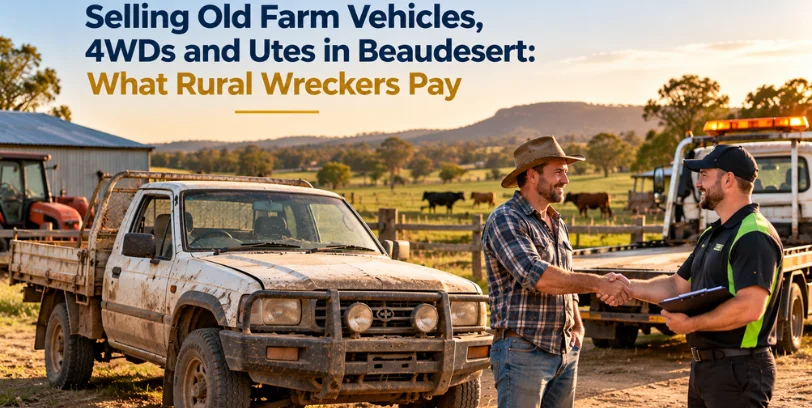
Car wreckers Beaudesert buyers are not buying your ute. They are buying the parts inside it, and the offer is a forecast of how quickly those parts will sell to somebody else in the Scenic Rim. Understand that and you can predict your own figure fairly closely.
This is the difference between a wrecker and a scrap yard, and it matters more on rural vehicles than on anything else. A metal buyer weighs your ute. A car wreckers Beaudesert operation looks at how many of that model are still working on properties within an hour, and prices accordingly. On the narrow set of models rural Queensland actually runs, that difference is substantial.
Why Rural Models Beat Passenger Cars
Farm country runs on a short list: HiLux, Land Cruiser, Navara, Triton, Ranger, Patrol, and older Falcon and Commodore utes. That concentration is the whole reason wreckers pay well for them.
When hundreds of the same model are working within an hour of Beaudesert, and every one of them will eventually need a starter motor, a diff centre, or a door, demand for those parts is constant and local. A wrecker can forecast that a HiLux gearbox will sell within weeks. They cannot forecast the same for a European sedan, because there is no local population needing the parts.
This produces the outcome that surprises owners most: a battered ute of a common model frequently outvalues a tidier vehicle of an uncommon one. Parts demand follows the roads and the paddocks, not the showroom.
What Comes Off First, and Why
A wrecker works in a rough order of value density. Knowing it tells you what your vehicle is really being assessed on.
Driveline: Engine, Gearbox, Transfer Case, Diffs
The bulk of the value on any four-wheel drive. Diesel engines from common utes are in constant demand, and transfer cases and differentials are expensive new, which makes serviceable used ones move quickly. A vehicle that still runs is worth notably more here, because the driveline can be tested rather than sold as untested.
Catalytic Converter
Small, and the highest value per kilogram in the vehicle because of its platinum, palladium, and rhodium content. Worth checking it is still fitted before requesting a quote, since converter theft reaches rural properties too.
Fitted Accessories
The category rural sellers most often forget. Steel trays, bull bars, towbars, dual battery systems, long-range fuel tanks, canopies, winches, snorkels, driving lights, and roof racks all have independent buyers. A serviceable steel tray sells regardless of what happens to the ute beneath it.
List every one of these when you ring. They are not assumed, and an assessor cannot value what they have not been told about.
Suspension, Steering and Brakes
Leaf springs, shock absorbers, hubs, steering boxes, and brake components. Individually modest, collectively meaningful, and in steady demand because corrugated-road use wears these out faster than anything else.
Panels, Doors, Trays and Glass
Steady sellers on common models, particularly doors and tailgates, which get damaged on properties more than any other panel. Dents matter less than you would expect; straight and complete beats cosmetically perfect.
The Remaining Shell
Priced by weight against the current metal rate. On a dual-cab with a steel tray this floor sits well above a passenger car’s, which is why heavy rural vehicles rarely attract a poor offer even when stripped.
What a Wrecker Checks on a Farm Vehicle
Rural vehicles get assessed differently from suburban ones, and four things get attention that would not on a city car.
- Chassis rails and mounting points. Years of towing beyond sensible limits, corrugations, and creek crossings take a toll. Fertiliser and chemical residue accelerate corrosion aggressively, so a ute that carried super or stock feed for a decade often has a chassis in worse condition than its bodywork suggests.
- Whether it has been cannibalised. The single biggest value reducer on rural properties. A ute that donated its battery, alternator, starter, wheels, and a door to keep another one running is worth a fraction of a complete one.
- Fire and heat damage. Grass fires and burn-offs reach vehicles more often than people expect. Heat destroys wiring looms, seals, plastics, and the temper of structural steel, which removes most of the parts’ value at once.
- How long it has been sitting. A vehicle that has been in the same paddock for a decade has sunk, and the underside has corroded from persistent ground moisture. It is also harder to recover, which is an access matter worth flagging when booking.
The Donor Vehicle Question
Worth thinking about before you strip anything else off.
Keeping a second vehicle as a parts source is sensible right up until it is not. Each component that goes across was a reasonable decision individually, but the line sits at the driveline and the converter. Once the engine and catalytic converter have gone, most of the recoverable value has gone with them, and what remains is largely weight. Our guide on whether to part out or sell a car whole works through that arithmetic.
If you are going to keep stripping it, do so knowing what it costs. If you are going to sell it, sell it before the driveline goes.
How to Describe a Farm Vehicle So the Quote Holds
Rural vehicles are the hardest to describe accurately, because they have usually been modified, repaired, and partially stripped over decades by more than one owner.
Work through it in four passes. First the driveline: is the engine still in it, does it turn over, is the gearbox attached, and are the transfer case and diffs still there? Second, underneath: is the catalytic converter present, and press along the chassis rails and mounting points for flex or flaking.
Third, the accessories: walk around and name every fitted item, including things that have been there so long they stop registering as separate. The tray, the bull bar, the towbar, the second battery, the tank, the canopy, the winch, the lights.
Fourth, what has gone. Parts sold years ago, components donated to another vehicle, items removed by a previous owner. An assessor finds these on arrival regardless, and a quote built on the full picture is the one that survives the driveway.
Machinery, Trailers and Trucks
Rural clear-outs rarely stop at cars, and the same logic extends with adjustments.
Old tractors are extremely dense in ferrous metal, which puts a high floor under them even when seized solid. Where the model is still working on properties nearby, parts demand can be stronger than any car’s, because agricultural machinery stays in service for decades.
Steel trailers hold solid value in materials, and their running gear — axles, springs, hubs, and couplings — is readily reusable. Old farm trucks combine substantial weight with diesel engines and gearboxes that remain in demand. With trucks, the practical issue is access rather than value, since one that has not moved in fifteen years may need specific equipment.
Selling Several at Once
Most Scenic Rim clear-outs involve several vehicles rather than one. Collecting four from a single address costs far less per vehicle than four separate trips, and that efficiency is reflected in the offer. Quote them together. Registration status does not affect the figure, though you will need to demonstrate ownership, and details are on the Queensland Government website. Our guide on selling multiple old cars for cash in QLD covers the process.
Ownership is worth sorting early on rural properties. Vehicles that came with the land, or changed hands between neighbours on a handshake years ago, often have no paperwork trail. A statutory declaration supported by land ownership documents is the usual path, and arranging it beforehand avoids a wasted trip. Our Beaudesert regional selling guide covers more of the local picture.
Areas Covered
Collection runs throughout the Scenic Rim: Beaudesert township, Boonah, Jimboomba, Canungra, Rathdowney, Tamborine, Kooralbyn, Veresdale, Gleneagle, and surrounding rural properties. Long unsealed driveways and paddock access are routine, though ground conditions after heavy rain are worth mentioning when booking. Our guide covering Boonah to Jimboomba goes further into the coverage.
What Scenic Rim Sellers Say
“Very good man” — William T. ★★★★★
“Very quick and easy. Really nice bloke. Highly recommend” — Tamas D. ★★★★★
Clearing the Shed or the Back Paddock?
Utes, four-wheel drives, tractors, trailers, and paddock bashers all considered. Our car wreckers Beaudesert service pays up to $9,999 depending on the vehicle, with free collection from rural properties.
■ Call 0435 955 334 — 6 AM to 8 PM, seven days
■ Licensed dismantling and compliant processing — see car wreckers
■ Multiple vehicles quoted together — cash for cars Beaudesert or cash for scrap cars
Frequently Asked Questions About Car Wreckers Beaudesert
What do car wreckers Beaudesert operators pay for old farm vehicles?
Car wreckers Beaudesert offers are built from parts demand rather than the vehicle’s appearance. Common rural models such as the HiLux, Land Cruiser, Navara, Triton, and Ranger have hundreds of working examples across the Scenic Rim needing components, which supports strong offers. The driveline and catalytic converter carry most of the value, with fitted accessories adding independently.
Do bull bars, trays and dual batteries add to the offer?
Yes, and they are the most commonly overlooked items at quote time. Steel trays, bull bars, towbars, dual battery systems, long-range tanks, canopies, winches, snorkels, and roof racks all have independent buyers. List every one of them when you ring, because an assessor cannot value what they have not been told about.
Does a rusty chassis make a farm ute worthless?
No. For car wreckers Beaudesert valuations, chassis corrosion reduces the figure but does not eliminate it, because the engine, gearbox, transfer case, differentials, converter, tray, and accessories all remain recoverable. Structural rust changes which value stream applies rather than whether the vehicle is worth buying.
Why does a battered common ute beat a tidy uncommon car?
Because parts demand follows what is still working locally. A wrecker can forecast that a HiLux gearbox will sell within weeks to somebody nearby. There is no equivalent local population needing parts for an uncommon model, so those components sit rather than sell.
What reduces a farm vehicle’s value the most?
Cannibalisation, by a wide margin. A ute that has donated its battery, alternator, starter, wheels, and a door to keep another vehicle running is worth a fraction of a complete one. Fire damage, chemical contamination, and years of ground contact also reduce value substantially.
Will you collect tractors, trailers and old farm trucks?
Yes. Tractors are dense in ferrous metal with a high floor value, and where the model still works locally, the parts demand can exceed any car’s. Steel trailers hold value in materials and running gear. With trucks, access is usually the practical consideration rather than value.
Can you reach properties with unsealed driveways around Beaudesert?
Yes. Car wreckers Beaudesert collection reaches properties on long unsealed driveways, cattle grids, and paddock access are routine throughout the Scenic Rim. After sustained rain, a track that carries a ute comfortably will bog a loaded tilt tray, so mention ground conditions when booking and the collection can be timed accordingly.
Clearing rural vehicles? Call 0435 955 334 or contact A2Z Car Removals for a free quote.
Comments are closed