
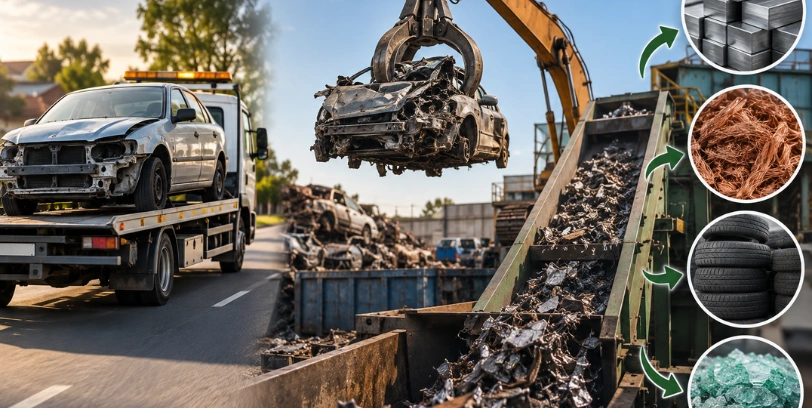
Around 95 per cent of the vehicle on your driveway will be recovered and reused. That figure surprises most people, and it is also the reason a scrap car removal Brisbane operator can pay you for something you were told was worthless.
This is not a walkthrough of the collection process. It is a breakdown of the vehicle itself — component by component, material by material — showing where each part ends up and, more usefully, which parts carry the money. Once you can see that, you can look at your own car and make a fair estimate of where it sits.
First: Depollution, Which Is Legally Required
Nothing happens to a vehicle until it has been depolluted. This is not optional and it is not a courtesy — it is an environmental obligation, and it explains why informal backyard operators cannot legally do what a licensed facility does.
Every fluid comes out and goes to a separate stream: engine oil, transmission and differential oil, brake fluid, power steering fluid, coolant, fuel, and air conditioning refrigerant. Refrigerant is the strictly controlled one, since venting it to atmosphere is an offence. Then the battery is removed, along with airbag units, mercury switches in older vehicles, and the fuel tank.
Waste oil recovered this way is filtered and re-refined rather than discarded. Coolant is treated before disposal. Queensland publishes waste management requirements for business covering how licensed operators handle each stream.
Important Read: How Much Is My Scrap Car Worth in Brisbane? Real Insights That’ll Surprise You
The Materials, Ranked by What They Are Actually Worth
Here is the part almost no article covers honestly. These are the components in rough order of value density, not size.
1. The Catalytic Converter
Physically small, disproportionately valuable. The ceramic honeycomb inside is coated with platinum, palladium, and rhodium. Rhodium in particular has traded at extraordinary prices in recent years, which is precisely why converter theft became widespread across Australian cities. Recovered converters go to specialist refiners who extract and re-refine the precious metal content. A single converter can be worth more than the entire remaining body shell of a small car.
2. Reusable Mechanical Components
Engines, gearboxes, differentials, alternators, starter motors, air conditioning compressors, ECUs, and injectors. If a component tests serviceable and there is demand for that model on Queensland roads, it is far more valuable sold as a working part than melted down. This is the stream that separates a good offer from a poor one, and it is why a common model outperforms a rare one.
3. Body Panels, Lights and Interior Trim
Doors, bonnets, guards, bumpers, headlight assemblies, tail lights, mirrors, seats, and dashboards. Lower value individually, but they move steadily because panel repairers and private owners prefer second-hand originals to aftermarket copies. Undamaged panels on a common model are worth removing; damaged ones go straight to metal.
4. Wheels and Tyres
Alloy wheels are aluminium and carry solid scrap value even when kerbed. Steel wheels are worth less. Tyres are the awkward one — they carry negative value in most cases, meaning the facility pays to dispose of them. Roadworthy tyres are resold; the rest are shredded for crumb rubber used in road surfacing, playground softfall, and industrial matting.
5. Copper Wiring
A wiring loom contains a surprising quantity of copper, and copper consistently outperforms steel per kilogram. Looms are stripped and the copper separated from the insulation. It is not a headline number on any single vehicle, but it is far from nothing.
6. The Steel Shell
What remains after everything above is removed is largely steel, and steel is the floor beneath every offer. It is priced by the tonne against the prevailing market rate, which is why kerb weight matters so much once a car is genuinely beyond repair. The shell is baled or shredded and returned to steel mills as feedstock for new production.
7. Glass and Plastics
Windscreens are laminated — glass bonded to a plastic interlayer — and require separation before the glass can be recycled. Side windows are toughened and easier to process. Bumpers and interior plastics are increasingly recovered and pelletised rather than sent to landfill, though this remains the hardest stream to handle economically.
What the Five Per Cent Is
If roughly 95 per cent is recovered, the remainder is what the industry calls shredder residue: mixed foam, fibre, composite, and contaminated fragments that cannot practically be separated. Recovery rates continue to improve as processing technology develops, but this fraction is currently the honest limit.
It is worth understanding why this residue is difficult. Modern vehicles use bonded composites, multi-layer plastics, and foams that were engineered for crash performance and weight reduction rather than for separation at end of life. A seat base might combine steel frame, polyurethane foam, textile, and adhesive in a single moulded unit. Separating those cleanly costs more than the recovered material is worth, so the economics stall before the technology does.
Newer vehicles entering the waste stream are gradually improving on this, since manufacturers now design with disassembly in mind more than they once did. Electric and hybrid vehicles introduce a different challenge again, because high-voltage battery packs require specialised handling and their own recovery pathway entirely.
The economics of recovery versus landfill are shaped in part by Queensland’s waste disposal levy, with current rates published by the Queensland Government. End-of-life vehicles sit within that broader resource recovery framework.
The Timeline: From Your Driveway to a Steel Mill
People often assume a scrapped car disappears into a crusher the same afternoon. The real timeline is considerably longer, and the reason is money — every stage that recovers value takes time.
Days One to Two: Arrival and Assessment
The vehicle is logged against its VIN, checked against the written-off vehicle register, and assessed for which route it takes. A vehicle with strong parts demand is set aside for dismantling. One that has already been stripped goes almost directly to processing.
Week One: Depollution
Fluids, battery, airbags, and fuel tank are removed and separated into their respective streams. This is the stage that legally must happen before anything else, and it is completed early so the vehicle can be safely handled thereafter.
Weeks One to Four: Component Recovery
Serviceable parts are removed, tested, catalogued, and listed. This is by far the slowest stage, because a gearbox has to be checked before it can be sold as a working gearbox. Vehicles with high parts demand can sit in dismantling for weeks while components are progressively pulled as orders come in.
Important Read: How to Get Cash for Cars Brisbane Without a Roadworthy
After Recovery: Baling and Shredding
Only once the vehicle has given up everything worth removing does the shell go to baling or shredding. Shredded material passes through magnetic and eddy-current separation, which divides ferrous metal from aluminium and other non-ferrous fractions. Each stream is then sold to its own market.
Finally: Back Into Production
Recovered steel returns to mills as feedstock. Because steel is infinitely recyclable without losing structural quality, the metal in a car built in the 1990s may already have lived a previous life as something else entirely, and will live another after this one.
How This Translates Into Your Offer
Now the practical payoff. Knowing the material breakdown lets you predict the shape of your own quote.
- A complete vehicle of a common model carries the most recoverable value, because the parts stream is live. This attracts the strongest offers regardless of whether it runs.
- A heavy vehicle that has been stripped is valued largely on weight. The floor is higher than a small car, but the parts stream is gone.
- A small car with the converter already removed sits at the bottom of the range. Light weight plus the single most valuable component missing.
- A rare or imported model in poor condition often surprises owners by attracting less than expected, because parts demand follows how many of that model are still on the road nearby.
Current metal market conditions shift this baseline over time, which we cover in more detail in our breakdown of scrap car prices in 2026.
Why This Matters When Choosing a Scrap Car Removal Brisbane Operator
A buyer with access to all of these streams can pay more than one who only has access to metal. That is the entire competitive difference in scrap car removal Brisbane pricing, and it is worth asking about.
It also has an environmental dimension. A vehicle processed at a licensed facility has its fluids captured, its refrigerant recovered, and its materials returned to production. A vehicle abandoned on a block leaks oil and coolant into soil for years. Whether your car is a junk car or a wrecked vehicle, the destination should be the same.
What Queensland Sellers Say
“Very quick and easy. Really nice bloke. Highly recommend” — Tamas D. ★★★★★
“Good service, very efficient service” — Maria P. ★★★★★
“Awesome!! Great to deal with! Will use again!!!” — Lucas Y. ★★★★★
Find Out What Your Vehicle Is Worth
A2Z Car Removals pays up to $9,999 depending on the vehicle, with free collection anywhere in Brisbane and surrounding regions. Every vehicle we take is processed through licensed channels.
◆ Call 0435 955 334 — 6 AM to 8 PM, seven days
◆ Free removal included — see our full car removal service
◆ Serving Brisbane and regional Queensland
Frequently Asked Questions
Where does your scrap car go after collection?
After scrap car removal Brisbane, it goes to a licensed facility for depollution first, where all fluids, the battery, airbags, and fuel tank are removed. Reusable components are then recovered for the parts market, the catalytic converter goes to a precious metal refiner, and the remaining steel shell is baled or shredded and returned to steel mills. Roughly 95 per cent of the vehicle is recovered.
What part of a scrap car is worth the most?
By value density, the catalytic converter, because it contains platinum, palladium, and rhodium. By total contribution, reusable mechanical components such as the engine and gearbox usually contribute most, provided there is demand for that model.
Does my scrap car need to run to have value?
No. A non-running vehicle still contains recoverable parts, precious metals in the converter, copper wiring, and a steel shell priced by weight. Whether it runs affects which value stream applies, not whether the vehicle is worth anything.
Why do heavier cars get higher scrap offers?
Because the steel shell is priced by the tonne against the prevailing metal rate, so weight sets the floor value. Above that floor, parts demand matters more, which is why a light but popular model can outvalue a heavy but unwanted one.
What happens to the tyres and fluids from my car?
Fluids are captured separately during depollution, with waste oil re-refined, and refrigerant recovered rather than vented. Roadworthy tyres are resold, and the remainder are shredded into crumb rubber for road surfacing, playground softfall, and industrial matting.
Is scrap car removal in Brisbane environmentally regulated?
Yes. Depollution is a legal requirement for every scrap car removal Brisbane operator before any vehicle is dismantled or processed, covering fluid capture, refrigerant recovery, and safe handling of batteries and airbag units. This is a key difference between a licensed operator and an informal one.
Does a missing catalytic converter reduce my offer?
Yes, noticeably. It is the single most valuable component by weight in most vehicles. Converters are commonly stolen, so it is worth checking whether yours is still fitted before requesting a quote, and mentioning it either way.
Want a figure for your vehicle? Call 0435 955 334 or visit A2Z Car Removals for a free quote.
Comments are closed